Open post Advanced robotic welding cell operating at a Michigan metal fabrication facility

New Welding Technology: What Michigan Manufacturers Need to Know

New welding technology is moving faster than most Michigan manufacturers can keep up with. Robotic cells that run 24 hours, AI systems that catch defects before the arc even moves on, laser welding that produces joints in seconds instead of minutes – these are not future-of-manufacturing concepts anymore. They are running in fabrication shops across Southeast Michigan right now. At Motor City Metal Fab, we work with automotive suppliers, aerospace contractors, and industrial manufacturers across the Detroit metro, and the gap between shops using these technologies and shops still on manual processes is widening every quarter. This guide covers what the new technologies actually do, where each one applies, how they reduce rework and cut cycle time, and what Michigan manufacturers need to evaluate before adopting them.

What Is the Latest Welding Technology in 2026?

The welding industry has consolidated around four technology categories that are genuinely reshaping production economics: collaborative robots (cobots), AI-powered weld monitoring, laser hybrid welding, and digital twin simulation. Each one addresses a different bottleneck – labor dependency, defect rates, cycle time, and process repeatability. Understanding what separates them matters before committing capital.

Cobots and Collaborative Welding Robots

Cobots are the fastest-growing segment in welding automation. Unlike traditional industrial welding robots – which require safety caging, extensive programming, and weeks-long installation – cobots are designed to work within arm’s reach of human operators. They carry tactile sensors that halt operation the moment contact is detected, and most modern units can be reprogrammed between jobs in hours rather than days. For Michigan job shops running high-mix, lower-volume work, that flexibility is what makes automation practical for the first time. Deployment costs have dropped roughly 60% compared to traditional robot cells, and a two-bay cobot welding setup can match the output of three to four manual welders while holding consistent parameters across every shift. The global robotic welding equipment market is projected to reach $10 billion by the end of 2026 – cobots are driving the majority of that growth because they fit manufacturing environments where hard automation never could.

AI-Powered Weld Monitoring Systems

AI weld monitoring captures arc parameters – voltage, current, wire feed speed, travel speed – at millisecond intervals and runs them against learned defect signatures in real time. When a parameter drifts outside the acceptable range, the system either flags the weld for inspection or adjusts the parameter automatically before the bead is finished. Machine learning algorithms built on thousands of weld cycles now predict defects with accuracy above 94%, meaning shops catch bad welds before they reach downstream assembly or inspection. The practical outcome: scrap rates that used to run 3-5% in manual environments drop below 1% with AI monitoring in place. For Michigan manufacturers supplying automotive tier-1 contracts where weld traceability and documented quality are contract requirements, AI monitoring also generates the data trail automatically – a benefit that goes beyond productivity into compliance.

Laser Hybrid Welding

Laser hybrid welding combines a focused laser beam with a conventional MIG arc in a single pass. The laser provides deep penetration and precise heat control; the MIG arc fills the joint and handles gap tolerance. The result is a process that runs 5-10 times faster than traditional MIG on structural work, produces a minimal heat-affected zone (HAZ), and handles fit-up variation that pure laser welding cannot. Michigan’s automotive supply chain has adopted laser hybrid extensively for EV battery enclosures, where precision and thermal control are both critical – aluminum battery cases cannot tolerate the distortion that conventional welding introduces.

Digital Twin Simulation and IoT-Connected Welding

Digital twin simulation models the weld joint, material, and process parameters in software before the first arc is struck. It predicts distortion, identifies stress concentration points, and optimizes the weld sequence to minimize warpage – eliminating the trial-and-error rework that costs shops time and material on prototype runs. Alongside simulation, IoT-connected welding power sources now transmit operating data to cloud dashboards via standard industrial protocols, enabling predictive maintenance scheduling based on actual machine behavior rather than fixed calendar intervals. A machine flagging anomalies in arc stability two weeks before a failure is a fundamentally different cost structure than one that fails mid-production run.
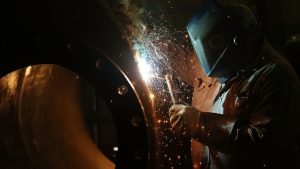
Welding cobot working alongside a technician on a metal assembly in a Michigan fabrication shop
Collaborative welding robots (cobots) allow Michigan fabricators to run advanced welding systems on high-mix work without the setup time traditional industrial robots require.

How Robotic Welding Systems Improve Productivity

The productivity case for robotic welding is straightforward at the numbers level: automated systems improve throughput by 300-500% over manual welding, operate continuously without fatigue, and hold weld parameters within ±2% tolerance across millions of repetitions. The more useful question for Michigan manufacturers is where those gains actually show up in the cost structure – and where the limits are.

Throughput and Cycle Time Gains

A robotic welding cell running qualified procedures on a repeat assembly produces at a steady arc-on rate that manual stations cannot match. Manual welding involves repositioning time, breaks, fatigue degradation in parameter consistency across a shift, and natural variation in travel speed. Robotic cells eliminate all of those variables. For assemblies with defined weld sequences – frames, brackets, enclosures, structural subassemblies – a typical Michigan job shop sees cycle time reductions of 40–60% after implementing a robotic cell on their highest-volume part families. That reduction compounds across multi-shift operations.

To understand how advanced welding technology intersects with dimensional precision across the full fabrication workflow, see how CNC machining maintains tight tolerances on components that feed directly into welded assemblies – keeping the tolerance stack controlled from raw material to finished part.

Rework and Defect Reduction

The defect rate gap between robotic and manual welding is significant: robotic systems average below 0.1% defect rates in production environments versus 3-5% in manual welding, according to AWS Foundation data. Each defect avoided eliminates downstream costs – rework labor, scrap material, delayed shipment, and potential warranty exposure. For manufacturers running high-compliance work in aerospace or medical device supply chains, defect rate documentation is itself a contract requirement. Robotic systems generate that data as a byproduct of operation.

Challenges for Small and Mid-Size Michigan Fabricators

The honest picture includes the barriers. Initial investment for a complete robotic welding cell runs $50,000-$250,000 depending on reach, payload, positioner configuration, and tooling. ROI timelines in medium-volume environments typically land at 18-24 months, which requires capital planning and a financing strategy. Integration into existing production lines involves fixturing modifications, workflow sequencing changes, and operator retraining – all of which extend the ramp-up period. The workforce transition matters too: robotic welding requires operators who understand programming, troubleshooting, and quality monitoring rather than pure arc technique. Michigan community colleges and technical schools have partnered with fabricators to build apprenticeship tracks that address this, but the skill gap is real, and the training pipeline is still catching up to demand.

For manufacturers weighing automation against the region’s skilled labor shortage, the situation is covered in depth in this post on the welder shortage crisis hitting Southeast Michigan manufacturing – which directly affects the ROI calculation for automation investment.
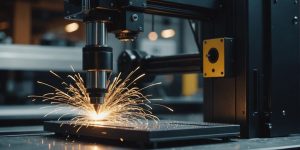
Automated welding production line showing cost reduction through robotic precision at Detroit metal fabrication facility
Our automated production line utilizes advanced robotics to achieve significant cost reduction and unmatched precision in every metal fabrication project.

Laser Welding vs. Traditional MIG Welding: When Each Makes Sense

Laser welding and MIG welding are not competitors in most manufacturing environments – they solve different problems. Choosing between them depends on material thickness, joint geometry, production volume, and whether distortion control or penetration depth is the priority.

Where Laser Welding Wins

Laser welding delivers its advantages on thin materials (typically under 3mm), precision assemblies, dissimilar metal joining, and applications where heat input must be minimized. The focused beam creates a narrow weld pool with a heat-affected zone a fraction of what MIG generates – which means aluminum components, stainless steel housings, and complex geometries come off the weld station with minimal distortion and no post-weld straightening. Processing speed is a major differentiator: next-generation fiber laser systems run 5-10 times faster than TIG welding and significantly faster than conventional MIG on appropriate material thicknesses. In aerospace applications, laser welding is now standard for joining titanium and aluminum-lithium alloy components where warpage is a disqualifying defect. Michigan’s EV battery manufacturing supply chain relies on laser welding for aluminum enclosures specifically because thermal control and cleanliness of the joint are requirements the process meets reliably at production volume.

For a deeper look at how laser technology works across cutting and joining applications at MCMF, the laser and waterjet cutting services page covers our full laser capability in precision cutting – which often feeds parts directly into the welding workflow.

Where MIG Welding Still Dominates

MIG welding remains the right choice for structural steel over 6mm, outdoor and field applications, high-deposition-rate work, and assemblies where deep penetration into thick material is the requirement. It tolerates joint fit-up variation that laser welding cannot, requires less precise fixturing, and runs on consumable wire that keeps operating costs lower per pound of weld metal deposited. For heavy fabrication – frames, heavy equipment components, structural subassemblies – MIG and its variants (FCAW for even higher deposition, SAW for long seam work) are still the production workhorses. The “better” choice is always application-specific.

Applications in Automotive and Aerospace

Michigan’s automotive manufacturing environment uses both processes across different assemblies. Body-in-white structural work uses robotic MIG at high volume. EV battery enclosures and motor housings use laser. Interior component joining uses ultrasonic. Prototype work uses TIG for flexibility. Advanced fabrication shops in the Detroit area that can run multiple welding processes in-house handle the full range of automotive supplier work without subcontracting individual operations – which is a direct cost and lead time advantage. Welding and fabrication services that span multiple processes under one roof eliminate the handoffs where quality and schedule risk accumulate.

Ultrasonic Welding: The Precision Process Michigan Manufacturers Are Adopting

Ultrasonic welding uses high-frequency vibration – typically between 15 and 70 kHz – to generate localized friction heat at the joint interface, bringing the materials into a plastic state that forms a molecular-level bond without introducing bulk heat into the assembly. No filler metal. No shielding gas. No arc. The process runs in cycle times under two seconds and uses up to 80% less energy than resistance welding for comparable joints.

How It Reduces Distortion and Energy Use

Because ultrasonic welding does not melt the parent material – it plasticizes the interface zone only – distortion and warpage are virtually eliminated. This matters significantly for precision assemblies where dimensional stability after joining is a specification requirement. Electronic enclosures, sensor housings, medical device components, and EV wiring harness connectors are typical applications where conventional welding heat would disqualify the process entirely. The energy efficiency advantage also compounds across high-volume production: for Michigan manufacturers running automotive wiring harness or electronic component assembly, the operating cost difference over a production year is material.

Key Industries Using Ultrasonic Welding in Michigan

In Michigan’s manufacturing ecosystem, ultrasonic welding is active across automotive (wiring harnesses, interior trim assemblies, battery terminal welding in EVs), electronics (smartphone components, circuit connections), and medical devices (clean room-compatible joins with no contamination risk). The EV transition is specifically driving adoption of ultrasonic welding for battery pack assembly because the process can join dissimilar conductor materials – copper to aluminum, for example – without the intermetallic compounds that resistance welding creates at the joint. Michigan’s position at the center of the EV supply chain transition makes this a growing process requirement, not a niche one.

For context on how Michigan’s EV manufacturing growth is creating broader demand for advanced fabrication capabilities, see our analysis of Michigan’s EV transition and the demand it creates for custom metal fabrication.

Digital weld monitoring dashboard displaying real-time arc parameters and quality data at a Michigan welding facility
IoT-connected welding power sources and AI monitoring software capture arc data at millisecond intervals, enabling predictive defect detection and full weld traceability for automotive and aerospace supply chains.

How to Modernize Your Welding Process with Digital Technology

Modernizing a welding process does not mean replacing every piece of equipment. It means introducing the data collection and control systems that turn welding from a craft-dependent variable into a measurable, manageable production process. Digital welding technology operates at three levels: process control (parameter management in real time), quality documentation (traceability and compliance records), and predictive operations (maintenance forecasting and yield optimization).

Why Digital MCU Control Is Becoming the New Standard

Microcontroller unit (MCU) control in modern welding power sources replaces the analog knob-and-dial parameter setting that older equipment uses. A digital MCU system sets and holds voltage, amperage, wire feed speed, and arc length electronically – eliminating the drift that happens when an analog machine heats up, when contact tips wear, or when input power fluctuates. The practical effect is weld-to-weld consistency that analog machines cannot achieve. On high-mix production work with tight tolerance requirements, MCU-controlled machines reduce parameter-related defects substantially, and they log every weld cycle automatically for quality records. That last point is driving adoption: customers in aerospace, defense, and medical device supply chains increasingly require documented weld data with shipments, and MCU-controlled machines generate it as a byproduct of operation.

Weld Data Analytics and Real-Time Monitoring

IoT-enabled welding power sources transmit operating data – arc voltage, wire feed rate, travel speed, heat input – to cloud or on-premises analytics platforms after every weld cycle. Over time, this data set reveals process drift before it produces defects, identifies equipment that needs maintenance before it fails, and builds the empirical baseline for process optimization. Sensor technologies feeding these systems include thermal imaging cameras, acoustic emission sensors for crack detection, and high-speed cameras capturing arc behavior at up to 10,000 frames per second. For manufacturers running ISO 3834 – or AS9100-certified welding operations, this digital data trail is moving from optional to required by their customer quality agreements.

Digital vs. Manual Welding Documentation

Manual weld documentation – paper travelers, handwritten weld logs, binder-based WPS records – creates audit exposure and limits traceability. When a weld failure occurs in the field, tracing it back to the specific welder, machine, parameters, and time of production is slow and often impossible with paper systems. Digital weld management systems (WQMS) capture operator identification, machine ID, weld procedure specification applied, and all measured parameters tied to each weld ID on the part. That data ships with the part as a digital package. For tier-1 automotive and aerospace customers, this capability is becoming a vendor qualification criterion. Shops still running paper documentation are increasingly disadvantaged in competitive bids.

Laser welding system producing a precision joint on an aluminum EV battery enclosure component
Laser hybrid welding achieves 5–10x the processing speed of conventional TIG while producing a minimal heat-affected zone – making it the process of choice for EV battery enclosures and aerospace components in Michigan’s manufacturing supply chain.

How Advanced Filler Metal Technologies Enhance Welding Productivity

Filler metal selection is one of the most overlooked productivity variables in welding operations. Most shops standardize on a small number of wire types and stay there – but the range of available filler metal formulations has expanded significantly, with meaningful differences in deposition rate, spatter generation, and mechanical properties of the finished joint.

Metal-cored wires, for example, produce higher deposition rates than solid wire at equivalent amperage, run at faster travel speeds, and generate significantly less spatter – reducing post-weld cleanup labor that often runs 30-40% of total welding time in manual operations. Low-hydrogen electrodes and flux formulations designed for high-strength steel produce the minimum hydrogen diffusion that prevents cold cracking in structural work. Nickel-bearing filler metals handle dissimilar metal applications where standard wire degrades joint properties. The right filler metal selection, matched to the specific base material and application requirement, reduces rework, improves mechanical properties, and cuts cycle time – without adding capital equipment cost.

For automotive manufacturers working with high-strength steel, aluminum alloys, or the dissimilar metal combinations that EV component assembly increasingly demands, filler metal selection is a process optimization lever that pays back immediately. Reviewing CAD design and CAM manufacturing services alongside welding process planning catches material-filler compatibility issues before the first piece runs.

Welding Safety Improvements Through Automation and Advanced Technology

Automated welding systems reduce welder injuries by approximately 86% compared to fully manual operations, according to OSHA data. The mechanisms are straightforward: automation removes the operator from direct arc exposure, eliminates repetitive motion that causes cumulative musculoskeletal injury, and keeps personnel away from fume and UV radiation zones that create long-term health hazards.

Modern fabrication environments add wearable sensors that monitor exposure to fume particulates and UV radiation in real time, alerting workers before cumulative exposure limits are approached. Computer vision systems detect improper joint fit-up before the arc starts – catching the setup errors that cause burn-through, undercut, and structural failures before they become a scrapped assembly. Cobot welding systems include tactile and proximity sensors that halt all motion when a person enters the operating zone, making collaborative operation genuinely safe rather than theoretically safe.

The quality benefit of improved safety is real and underappreciated. Studies in controlled manufacturing environments show that welders working in ergonomically optimized, properly ventilated conditions produce measurably fewer defects than those working in environments with poor air handling, awkward fixture positioning, or high thermal discomfort. Safety investment and quality investment overlap significantly in welding operations.

How New Welding Technology Is Reshaping Detroit and Southeast Michigan Manufacturing

Detroit and Southeast Michigan operate one of the highest concentrations of welding employment in the country. The Great Lakes region’s manufacturing base – automotive assembly, tier-1 and tier-2 supply chain, aerospace fabrication, heavy equipment – represents a market where welding technology adoption directly affects competitiveness for supplier contracts.

Michigan’s EV transition is the single largest driver of technology change in local fabrication shops right now. Battery enclosure welding, motor housing assembly, thermal management component fabrication, and lightweight structural work for EV platforms all require welding capabilities – laser precision, ultrasonic for terminal connections, robotic consistency for high-volume battery pack components – that differ from the steel-dominant processes that served the ICE vehicle supply chain. Shops in Taylor, Downriver, Dearborn, and the broader Southeast Michigan corridor that have invested in advanced welding systems are winning contracts that their unmodified competitors cannot quote.

The welder labor shortage compounds this dynamic. The American Welding Society projects a shortfall of over 330,000 welding professionals nationally by 2028. Michigan is at the front of that shortage due to the concentration of demand and an aging workforce. Shops that automate the high-volume, repetitive welding work – freeing their experienced welders for complex fabrication, setup, and quality oversight – are better positioned to scale output than those competing for the same shrinking pool of manual welding labor.

Motor City Metal Fab operates in Taylor, Michigan, serving Detroit, the Downriver corridor, and Southeast Michigan manufacturers with welding and fabrication services that integrate CAD/CAM review, in-house CNC machining, and advanced welding processes under one roof. That in-house breadth is what allows clients to move from design to finished welded assembly without the quality and schedule risk that comes from coordinating multiple vendors. Michigan manufacturers evaluating advanced welding adoption can contact our team for a process consultation and free quote on their specific fabrication requirements.

For a broader view of how Michigan’s manufacturing evolution is creating new opportunities for fabricators adopting advanced capabilities, see why Michigan’s EV boom creates opportunities for precision metal fabricators.
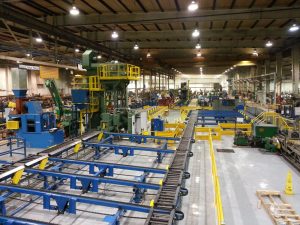
Motor City Metal Fab welding shop floor in Taylor Michigan showing in-house fabrication and welding operations
Motor City Metal Fab’s Taylor, Michigan shop runs welding, CNC machining, laser cutting, and powder coating in-house – giving Detroit-area manufacturers a single-source partner from raw material to finished assembly.

Frequently Asked Questions

Q1: What is the latest technology in welding in 2026?
The leading welding technologies in 2026 are AI-powered robotic welding systems with adaptive learning, laser hybrid welding that combines laser precision with MIG fill-pass capability, and ultrasonic metal welding for joining dissimilar materials without heat. Digital MCU-controlled power sources and IoT-connected weld monitoring platforms are also standard in advanced fabrication shops running compliance-grade work.

Q2: Why is digital MCU control becoming the new standard in welding?
Digital MCU control holds weld parameters electronically rather than relying on analog circuitry, which drifts with temperature and equipment wear. The result is arc stability and parameter consistency that analog machines cannot maintain across a full production shift. MCU-controlled machines also log every weld cycle automatically, generating the traceability records that aerospace, automotive, and medical supply chains increasingly require with each shipment.

Q3: What are the latest advancements in welding and fabrication technologies?
The most significant recent advancements are welding cobots (deployable in hours, not months), AI-driven defect detection running at production speed with greater than 99% accuracy, fiber laser welding systems processing at 5–10x the speed of TIG, and digital twin simulation that eliminates prototype trial-and-error by modeling weld distortion before the first arc is struck. IoT weld monitoring and cloud-based analytics are also reshaping how fabrication shops manage quality and equipment health.

Q4: How can manufacturers streamline their welding process with technology?
Start with a welding audit to identify the three to five highest-volume repeat assemblies in the current workflow – those are the automation candidates. Introduce MCU-controlled power sources to eliminate parameter drift. Add digital documentation at the weld station to replace paper travelers. Then evaluate cobot automation for the repeat work while keeping manual capability for complex or low-volume fabrication. Doing all three simultaneously is not required; each step produces measurable ROI on its own.

Q5: What technology helps reduce weld spatter and rework?
Metal-cored filler wire reduces spatter significantly compared to solid wire at equivalent parameters. MCU-controlled machines with pulse capability produce cleaner arcs with less spatter than constant-voltage machines running the same wire. At the process level, laser welding essentially eliminates spatter for compatible material thicknesses. At the monitoring level, AI weld inspection catches the parameter conditions that produce spatter-prone arcs before they produce a defective weld, allowing parameter correction mid-run.

Q6: Is welding advanced manufacturing?
Yes. Modern welding operations that integrate robotic automation, computer vision inspection, digital twin simulation, and IoT data collection are squarely within the Industry 4.0 framework of advanced manufacturing. The distinction between welding as a trade and welding as advanced manufacturing lies in the control, measurement, and data infrastructure around the arc – not the arc itself.

Q7: How can productivity be enhanced with advanced filler metal technologies?
Metal-cored wires run at higher deposition rates and faster travel speeds than solid wire, cutting arc-on time per unit. Low-spatter formulations reduce post-weld cleanup labor that often runs 30-40% of total time in manual operations. Matched properly to base material and application, filler metal upgrades are among the lowest-cost, fastest-ROI process improvements available – typically requiring no capital equipment change, only process re-qualification.

Q8: How can AI-enhanced welding automation reduce rework and scrap in high-mix production?
AI weld monitoring systems learn the parameter signatures of good and defective welds across a production history and apply that knowledge in real time. In high-mix environments where different parts run on the same equipment with different procedures, AI monitoring validates that the correct parameters are active before welding starts and flags deviations as they occur – not after the part is completed and inspected. The result in typical high-mix shops is scrap reduction of 60-80% compared to manual inspection workflows, with full data traceability per weld.

Q9: What are the advantages of robotic welding over manual welding?
The core advantages are throughput (300-500% improvement in production-environment comparisons), consistency (±2% parameter tolerance held across millions of repetitions), defect rate (below 0.1% versus 3-5% manual), and 24/7 operation capability. Robotic welding also removes operators from arc, fume, and UV exposure – reducing injury rates by up to 86%. The limitation is flexibility: manual welding handles complex geometry, low-volume work, and unusual joint configurations that robots require significant programming time to address.

Q10: How can Michigan manufacturers get started with welding automation?
Walk the production floor and identify repeat assemblies with defined weld sequences – those are the starting candidates. Document current cycle times and defect rates to establish the baseline ROI case. Contact local fabrication partners and automation integrators who understand Michigan’s automotive and industrial supply chain context. Motor City Metal Fab works with Michigan manufacturers on exactly this kind of process review – contact our team for a free quote and consultation.

Open post

Powder Coating Is Winning the Automotive Aftermarket – Here’s Why Detroit Suppliers Are Taking Notice

Motor City Metal Fab | Detroit, Michigan

The numbers are hard to argue with. U.S. consumers spent $52.65 billion accessorizing and modifying their vehicles in 2024, according to the Specialty Equipment Market Association’s 2025 Market Report, and that figure is expected to keep climbing at 4–5% annually through 2026. Pickup trucks alone account for a third of the entire specialty-equipment market. Those are exactly the vehicles whose owners demand brackets, frames, skid plates, exhaust components, and suspension hardware that hold up under real-world punishment — road salt, heat cycles, mud, and vibration.

For fabricators and aftermarket parts suppliers in and around Detroit, this sustained spending surge creates a production challenge that is easy to underestimate. The issue is not demand — demand is strong and getting stronger. The issue is finish quality. How do you deliver metal components with coatings that won’t chip, rust, peel, or fail when your customer installs them on a truck that sees Michigan winters? And how do you do it while staying compliant with tightening environmental regulations that are squeezing liquid paint operations harder every year?

Increasingly, the answer across the Metro Detroit supply base is industrial powder coating. And the shift is accelerating.

The Regulatory Clock Is Running Out for Liquid Paint

The U.S. Environmental Protection Agency has established national volatile organic compound emission standards for automobile refinish coatings under the Clean Air Act, requiring manufacturers and importers to limit the VOC content of finishing products. The EPA’s regulatory framework for automobile refinish coatings and VOC emission standards has been tightening for years, and the direction of travel is unmistakable. The agency has continuously reviewed and updated these standards, with each revision placing heavier compliance burdens on operations that rely on solvent-based liquid coatings.

Powder coating sits entirely outside these restrictions. Because it is applied as a dry material electrostatically and cured in an oven, it releases zero VOCs during application. No solvents evaporate into the air. No abatement hardware is required. No air permit thresholds are triggered. For a fabricator in a state like Michigan — which operates under both federal EPA standards and additional state-level air quality regulations — that distinction eliminates a meaningful category of operational and legal risk.

The compliance picture matters even more for suppliers embedded in automotive OEM supply chains. Tier 1 and Tier 2 procurement teams now routinely audit environmental compliance throughout their supplier networks, and some of the largest EV-focused OEMs have established sustainability criteria for their vendors that go beyond basic legal compliance. A shop finishing aftermarket brackets and enclosures with solvent-based paint is not just absorbing regulatory risk internally — it is potentially creating a disqualification issue for its most important customers. Companies that converted to powder coating years ago have permanently removed that conversation from their customer relationships.

The Aftermarket Fleet Is Aging Into the Sweet Spot

Beyond compliance, the demand dynamics for durable aftermarket parts have rarely looked better, and they are driven by a structural trend that is not going away. According to SEMA’s 2025 Market Report, the average vehicle age in the U.S. has climbed to a record high, pushed upward by rising new-car prices that are prompting more owners to keep and upgrade their existing vehicles rather than replace them. With the average transaction price for a new vehicle now approaching $49,000, a growing share of the American driving public is making the calculation that investing in a quality suspension upgrade or a set of durable underbody components is a better financial decision than a new car payment.

That math translates directly into sustained aftermarket parts demand — and it creates specific expectations around product quality. A vehicle owner who just spent $800 on aftermarket skid plates or a tow hitch bracket is not buying a part they expect to be refinishing in two years. They want a durable, corrosion-resistant finish that holds up for the life of the vehicle. Powder coating delivers that performance benchmark reliably, while liquid paint on comparable parts frequently fails under the salt, moisture, and heat exposure that characterize real-world use in markets like Michigan, Ohio, and the upper Midwest.

Suspension, exhaust, and engine control products are growing faster than the overall specialty equipment market, which is telling. These are precisely the categories where coating durability matters most. A chassis bracket or exhaust hanger that rusts out or chips at the powder interface is a warranty claim and a reputation problem. An equivalent part finished with quality industrial powder coating and proper surface prep can outlast the vehicle itself.

Equally important is the EV transition now underway within the aftermarket itself. As electric vehicles age out of warranty and into the independent aftermarket, they introduce a new category of fabricated metal components — battery enclosure brackets, thermal management structures, charge-port mounting hardware — that carry safety implications if their coatings fail. How EV production is specifically reshaping powder coating demand across the aftermarket supply chain is examined in How EV Production Is Reshaping Automotive Aftermarket Powder Coating Demand.

Powder Coating’s Operational Advantages Are Just as Compelling as the Regulatory Ones

Liquid paint operations are expensive in ways that are easy to undercount. Overspray cannot be reused, so material waste is built into every production run. Multi-step application processes — prime, base coat, topcoat, clear coat — compound labor costs and extend lead times. Solvent handling creates both compliance obligations and workplace hazards. Touch-up rates for liquid-painted components are higher because operator technique, ambient humidity, and surface temperature all affect the outcome in ways that are difficult to fully control.

Powder coating eliminates or substantially reduces each of these cost drivers. Overspray is collected and reused, driving material efficiency that compounds significantly on high-volume runs. The process is a single application step that cures in an oven — a consistent, controlled environment where the operator’s role is setup and quality monitoring rather than technique execution. This is why powder-coated parts produced from a well-managed line show dramatically lower batch-to-batch variation than liquid-painted equivalents.

Color consistency across large production runs is particularly valued by aftermarket distributors and OEM customers who assemble kits or package parts together. A production run of several hundred bracket assemblies needs to look identical — same sheen, same texture, same color depth. Achieving that with liquid paint requires ongoing process management and generates a meaningful rejection rate. Powder coating delivers that consistency more reliably because the process variables are controlled by equipment rather than by application skill.

Film thickness control matters as well, especially for precision components where coating buildup on mating surfaces, threads, or close-tolerance features can cause fitment problems. Proper masking and process management in a professional powder coating operation keeps critical dimensions clean while still delivering full coverage and adequate thickness on the surfaces that need protection. Understanding exactly what finish quality standards aftermarket parts suppliers need to meet — including the impact of base metal preparation, coating chemistry selection, and film thickness requirements — is covered in detail in Corrosion Protection and Finish Quality: What Automotive Aftermarket Parts Suppliers Need to Know in 2026.

What Metro Detroit Fabricators Should Be Asking Right Now

The automotive aftermarket in 2026 is a strong market with demanding customers. The same vehicle owner spending $52 billion on specialty equipment annually is also reading forums, watching installation videos, and comparing product reviews in detail before they buy. Finish quality shows up in those reviews. Rust-through after a single winter shows up even faster.

For fabricators and aftermarket component manufacturers in Metro Detroit, the current environment makes the powder coating question a strategic one rather than a technical curiosity. Is your current finishing process meeting the environmental compliance requirements your OEM customers expect? Can your coated parts survive the field exposure conditions of your target markets? Is liquid paint adding unnecessary cost through waste, rework, multi-stage application cycles, and touch-up labor that powder coating would eliminate?

Detroit has always competed on manufacturing capability. In 2026, the capability that increasingly matters to automotive aftermarket customers — both OEM buyers and end consumers — is a finish that is durable, consistent, compliant, and efficient to produce. Powder coating delivers all four, which is why the shops that made the conversion are not going back.

Motor City Metal Fab: Powder Coating for Detroit’s Automotive Aftermarket

Motor City Metal Fab provides powder coating services from our Taylor, Michigan facility, handling steel, aluminum, and stainless steel parts up to 25 feet in length. We serve automotive prototype developers, aftermarket suppliers, transportation equipment builders, and EV component manufacturers who need durable industrial finishes with fast turnaround.

Our Services Include:

Ready to get a quote? Contact Motor City Metal Fab to discuss your project requirements and turnaround needs.

Works Cited

“NEW SEMA RESEARCH: 2025 MARKET REPORT.” Specialty Equipment Market Association, 30 June 2025, www.sema.org/news-media/press-release/new-sema-research-2025-market-report. Accessed 25 Mar. 2026.

“Automobile Refinish Coatings: National Volatile Organic Compound Emission Standards.” U.S. Environmental Protection Agency, www.epa.gov/stationary-sources-air-pollution/automobile-refinish-coatings-national-volatile-organic-compound. Accessed 25 Mar. 2026.

Related Articles


Open post

How EV Production Is Reshaping Automotive Aftermarket Powder Coating Demand

Motor City Metal Fab | Detroit, Michigan

General Motors announced in August 2024 that it was retooling three U.S. plants to incorporate powder-coated battery enclosures and subframes. Ford’s Oakville assembly site, which launched EV production in late 2025, adopted a two-coat powder sequence to replace the traditional water-intensive e-coat dip process. These are not isolated choices — they are industry signals. When the two largest domestic automakers restructure their finishing processes around powder coating simultaneously, every supplier in their orbit needs to pay attention to what that means for their own operations.

For Metro Detroit fabricators and aftermarket component suppliers, the electrification shift is generating a new category of powder coating demand that is distinct from traditional performance parts work. Battery enclosures, thermal management brackets, charge-port mounting hardware, and underbody EV structures all require durable, corrosion-resistant, zero-VOC finishes. And as the EV fleet ages into the independent aftermarket, the volume of these components requiring finishing services is going to grow substantially over the next several years.

The EV Fleet Is Aging Faster Than Most Suppliers Expect

The numbers are worth examining closely. Battery electric vehicle registrations grew at an average annual rate of 28.8% between 2016 and 2023, according to the U.S. Department of Energy’s Alternative Fuels Data Center. That growth trajectory, even as it moderates from peak pace, has produced an installed base large enough to generate meaningful aftermarket demand as those vehicles age. An EV purchased in 2020 or 2021 is now five or six years old — approaching the service window where components start requiring attention, and well past the factory warranty period that previously absorbed those costs.

According to analysis from AAPEX and S&P Global Mobility published in 2025, the average age of all U.S. vehicles has climbed to 12.8 years, driven by high new-car prices keeping owners in their existing vehicles longer. The mid-age window of four to eleven years — historically the most active period for aftermarket parts spending — now contains more than 119 million vehicles. As EVs move into that window over the next several years, they bring with them a set of fabricated metal components that will need replacement, upgrade, and customization in exactly the ways conventional vehicle parts always have.

The critical difference is what those components are and what happens when their protective coatings fail. On a conventional vehicle, a corroded bracket or rusted mounting point is a maintenance inconvenience. On an electric vehicle, a compromised battery enclosure, degraded thermal management structure, or corroded high-voltage component mounting is a safety concern of a different order. That difference in consequence is directly driving higher coating specification requirements throughout the EV aftermarket supply chain, and it is filtering through to the fabricators and finishing shops that serve those suppliers.

OEM Sustainability Requirements Are Restructuring the Supplier Landscape

The EV supply chain was built from the beginning around environmental commitments that go significantly deeper than those in the conventional automotive industry. Major EV manufacturers have established sustainability criteria for their Tier 1 and Tier 2 suppliers that include finishing and coating processes — not just energy usage or packaging waste. These criteria are written into procurement contracts, audited during supplier qualification, and increasingly enforced through annual supply chain reviews.

Liquid paint operations release VOCs during application and require solvent storage, handling infrastructure, and air emission controls. In addition to the direct operating cost of that compliance infrastructure, liquid paint shops face the growing reality that their process disqualifies them from contracts with EV-focused OEM customers who have committed to zero-VOC supply chains. This is not a future risk — it is an active procurement criterion at several of the most significant EV manufacturers currently scaling U.S. production.

Powder coating eliminates this exposure entirely. Applied electrostatically as a dry material and cured in an oven, it releases no solvents and generates no VOC emissions during the coating process. For a Metro Detroit supplier looking to position itself for EV-related work — either directly with OEMs or through the Tier 1 and Tier 2 supply base — a powder coating finishing capability is increasingly a baseline requirement rather than a competitive differentiator.

The broader context of why powder coating has become the standard finishing method for the Detroit aftermarket supply base is covered in Powder Coating Is Winning the Automotive Aftermarket. Here’s Why Detroit Suppliers Are Taking Notice, which examines the regulatory and market forces driving the shift across all aftermarket categories, not just EV components.

EV Components Present Specific Technical Challenges That Require Expertise

EV-specific components are not simply conventional automotive parts made from different materials. They involve design characteristics that create meaningful powder coating challenges — and working with a finishing shop that understands those challenges is the difference between first-pass quality and expensive rework.

Battery enclosures and thermal management brackets frequently incorporate complex geometries with internal surfaces, tight radii, and blind pockets that are difficult to coat uniformly through standard electrostatic application. Proper spray technique, part orientation on the line, and gun angle are all critical variables for achieving adequate coverage in these areas without excessive buildup at edges and corners. Shops without experience finishing complex EV geometry produce predictable results: over-coated edges, under-coated recesses, and dimensional non-conformances at mating surfaces.

Material selection adds another layer of complexity. Aluminum alloys are used extensively in EV architecture for weight reduction, and they require surface preparation and coating chemistry that differs from steel finishing protocols. The pre-treatment process for aluminum — cleaning, conversion coating, and adhesion promotion — must be properly matched to the powder chemistry and cure cycle to achieve the corrosion protection performance EV customers require. Skipping or shortcutting pre-treatment on aluminum EV components is one of the most reliable ways to produce a coating that looks correct but fails prematurely in the field.

Masking precision is equally critical for EV components. Connectors, sealing surfaces, threaded features, and close-tolerance bores must remain completely coating-free while adjacent surfaces receive full coverage. On complex EV brackets and enclosures, this requires custom masking fixtures and careful inspection protocols — not the generic tape-and-plug approach that works adequately for simpler parts.

The Market Trajectory Makes This a Now Decision, Not a Later One

The automotive powder coatings market was valued at $13.60 billion in 2023 and is projected to reach $24.26 billion by 2030, with the aftermarket sector representing 40% of that total. EV-specific coating requirements — for battery enclosures, subframes, and underbody components — are among the fastest-growing subcategories within that market as production volumes scale and the installed fleet ages into the service window.

For fabricators and finishing shops in Metro Detroit, this trajectory creates a near-term positioning decision. EV aftermarket work is growing now. The OEM suppliers who need EV component finishing services are making vendor qualification decisions now. A shop that has demonstrated EV-specific coating capability — proper aluminum pre-treatment, complex geometry experience, masking precision, and zero-VOC process compliance — has a clear advantage in those conversations over a shop still finishing primarily conventional steel parts with liquid paint.

The technical standards governing what constitutes adequate corrosion protection and finish quality for automotive aftermarket parts — including EV components — are more demanding than many suppliers realize, and getting them wrong carries real commercial consequences. Those standards are examined in depth in Corrosion Protection and Finish Quality: What Automotive Aftermarket Parts Suppliers Need to Know in 2026.

The EV transition is not a future event for the Detroit supply base. It is the present reality. The fabricators and finishing operations that are building EV-relevant capability now will be far better positioned than those waiting for the demand to become impossible to ignore before they act.

Motor City Metal Fab: Powder Coating for EV and Aftermarket Components

Motor City Metal Fab provides powder coating services from our Taylor, Michigan facility, coating steel, aluminum, and stainless steel components up to 25 feet in length for automotive prototype developers, EV manufacturers, aftermarket suppliers, and transportation equipment builders.

Our Services Include:

  • Powder Coating Services — Zero-VOC industrial finishes built for automotive aftermarket and EV component requirements
  • Media Blasting Services — Complete surface preparation for proper adhesion on steel and aluminum substrates

Ready to discuss your EV or aftermarket component finishing needs? Contact Motor City Metal Fab today.

Works Cited

“What Is the Average Age of a Vehicle in the United States?” AAPEX, Automotive Aftermarket Products Expo, 27 June 2025, www.aapexshow.com/blog/average-vehicle-age. Accessed 25 Mar. 2026.

“Electric Vehicle Registrations by State.” Alternative Fuels Data Center, U.S. Department of Energy, afdc.energy.gov/data/10962. Accessed 25 Mar. 2026.

Related Articles


Open post

Corrosion Protection and Finish Quality: What Automotive Aftermarket Parts Suppliers Need to Know in 2026

Motor City Metal Fab | Detroit, Michigan

Here is a problem that costs Detroit-area aftermarket suppliers money every year, and most of them are underestimating it: finish failure. Not dramatic, obvious coating breakdown — the subtle kind. Slight chalking after one season of UV exposure. A thin rust blush at a fastener hole six months after installation. A small chip near a weld seam that spreads to a full corrosion bloom by the following spring. Each of these outcomes triggers the same downstream consequence — a warranty claim, a negative product review, a lost reorder — and each one traces back to decisions made in the finishing process, not in the part design itself.

The automotive aftermarket is unforgiving about this. According to SEMA’s 2025 Market Report, U.S. consumers spent $52.65 billion on specialty vehicle equipment in 2024. A meaningful share of that spending goes to performance and protection components — skid plates, suspension hardware, exhaust systems, tow equipment, roll bars — that customers specifically expect to outlast heavy use. When those parts fail cosmetically or structurally because of coating breakdown, the product gets blamed regardless of whether the base metal or the design deserved any criticism at all.

In 2026, getting corrosion protection and finish quality right is not just about customer satisfaction. It is increasingly a procurement requirement at the OEM level and a functional necessity as the aftermarket base expands into demanding EV-specific applications.

Why Most Aftermarket Parts Fail at the Finish, Not the Metal

The majority of corrosion failures on aftermarket parts are not material failures. They are process failures. The base metal — whether steel, aluminum, or cast iron — is typically adequate for the application. The coating chemistry, if properly applied and cured, would have performed. The failure happens in the gap between those two things: inadequate surface preparation, insufficient film thickness, improper masking that traps moisture, or a cure cycle that left the coating undertreated.

Surface preparation is where most failures begin. Metal parts arrive at a finishing shop contaminated with oils from machining and handling, mill scale from the forming process, and sometimes rust or oxidation from storage. Any of these contaminants sitting between the base metal and the coating layer creates an adhesion weakness that will eventually manifest as peeling, bubbling, or undercutting corrosion. The contamination is often microscopic — invisible to the naked eye — which is why skipping or shortcutting the prep stage produces failures that seem to come out of nowhere.

For steel parts destined for outdoor automotive applications, mechanical surface preparation — media blasting — is the most reliable way to achieve a profile that promotes genuine adhesion. Blasting removes contaminants, eliminates mill scale, and creates a surface texture that increases the mechanical bond area between the metal and the coating. Chemical cleaning alone, without that surface profile, leaves the coating sitting on a surface that looks clean but lacks the microscopic anchor points that long-term adhesion requires. A properly blasted and powder-coated steel bracket will outperform a chemically cleaned and liquid-painted equivalent in real-world exposure conditions by a substantial margin.

Film thickness is the second most common source of premature failure. Coating specifications for automotive aftermarket parts typically call for a minimum dry film thickness in the range of 2.5 to 4.0 mils, depending on the application. Below that threshold, the coating layer does not provide adequate barrier protection against moisture and salt intrusion, particularly at edges, corners, and welds where film coverage tends to be thinner. Many shops run their powder equipment and cure cycles to a schedule that looks adequate on flat test panels but delivers under-thickness coverage on complex parts with internal features, tight radii, and weld seams. Monitoring film thickness across a representative sample of production parts — not just on flat test surfaces — is the only way to confirm that the specification is actually being met in the areas that matter.

OEM Customers Are Raising the Bar on Documentation

The finish quality expectations that matter most to Metro Detroit aftermarket suppliers are increasingly coming from their largest customers rather than from end consumers. Tier 1 automotive buyers sourcing aftermarket brackets, guards, and hardware have moved beyond informal quality conversations to structured supplier qualification frameworks that include coating performance requirements. Salt spray resistance, UV weathering performance, chip resistance ratings, and adhesion test results are now commonly included in supplier technical packages, and they are verified — not just requested.

The U.S. Environmental Protection Agency’s standards for automobile refinish coatings establish the federal baseline for VOC compliance in automotive finishing operations, and those standards are a floor, not a ceiling. OEM-level customers routinely impose additional environmental and performance requirements that exceed federal minimums. A supplier whose quality documentation package stops at EPA compliance is not equipped for those conversations. A supplier that can demonstrate salt spray hours to ASTM B117, adhesion testing to ASTM D3359, and impact resistance performance has the objective third-party data those customers are looking for.

The SEMA 2025 Market Report data makes clear that the pickup and truck segment — the largest single category in the specialty equipment market — is driving a disproportionate share of parts demand. Truck owners are documented as the most active modifiers and the most demanding buyers in terms of product quality expectations. They are also operating their vehicles in exactly the environments that are hardest on coatings. A truck running in Michigan, Minnesota, or the Rocky Mountain states is exposing its aftermarket components to conditions that will surface coating failures within a single season if the finishing process was not done correctly.

How the finishing process fits into the broader competitive picture for aftermarket suppliers — and why Detroit fabricators specifically are converting from liquid paint to powder coating in large numbers — is examined in Powder Coating Is Winning the Automotive Aftermarket. Here’s Why Detroit Suppliers Are Taking Notice.

The EV Corrosion Protection Standard Is Higher Than Conventional Parts

EV-specific components are raising the floor on corrosion protection requirements even further. Battery enclosures, thermal management brackets, and high-voltage component mounting structures operate in environments where moisture intrusion and electrochemical corrosion can have consequences beyond cosmetic failure. An aftermarket supplier finishing EV battery enclosure hardware needs to meet a different standard than one producing truck bed accessories — and the finishing process, material selection, and quality verification need to reflect that difference.

Aluminum alloy components, used extensively in EV architecture for weight reduction, require coating chemistry and pre-treatment protocols specifically formulated for aluminum rather than repurposed steel finishing processes. Powder coatings formulated for steel adhesion do not perform equivalently on aluminum substrates without proper conversion coating pre-treatment. Suppliers finishing aluminum EV components on lines calibrated for steel work are producing parts that will look correct until they encounter sustained moisture exposure, at which point the coating delaminates from the substrate rather than providing the barrier protection the application requires.

How the EV transition is specifically reshaping powder coating demand and driving new technical requirements across the aftermarket supply base is examined in depth in How EV Production Is Reshaping Automotive Aftermarket Powder Coating Demand, which covers OEM sustainability criteria, EV fleet aging dynamics, and the specific component categories creating new finishing challenges for Detroit suppliers.

What a Credible Finishing Process Looks Like in 2026

For an aftermarket parts supplier sourcing powder coating services in Metro Detroit, a credible finishing operation in 2026 has several non-negotiable characteristics. Mechanical surface preparation — media blasting — is standard, not optional, for steel components going into outdoor automotive applications. Pre-treatment for aluminum substrates is chemistry-specific, not adapted from a steel line. Film thickness is monitored on production parts, not just test panels. Masking is custom-fitted for complex geometries rather than improvised. And cure cycles are calibrated to the specific substrate and part mass rather than run on a generic schedule.

Beyond process, documentation matters. The ability to provide customers with traceable film thickness measurements, cure records, and periodic adhesion testing data is increasingly expected by OEM buyers and is a practical differentiator when competing for programs where multiple finishing sources are being evaluated.

The automotive aftermarket is a large and growing market — $413.7 billion in light-duty aftermarket sales in 2024, projected to grow 5.1% in 2025 according to the Auto Care Association. The suppliers who capture a disproportionate share of that growth will be the ones whose products perform as advertised in the field. Finish quality is where that performance case is made or broken, and getting it right starts with the finishing process decisions made before the first part ever enters a customer’s hands.

Motor City Metal Fab: Industrial Powder Coating Built for Automotive Aftermarket Standards

Motor City Metal Fab provides powder coating services from our Taylor, Michigan facility, serving automotive aftermarket suppliers, prototype developers, EV component manufacturers, and transportation equipment builders. We handle steel, aluminum, and stainless steel parts up to 25 feet, with surface preparation through our media blasting operation on-site.

Our Services Include:

  • Powder Coating Services — Durable, corrosion-resistant industrial finishes meeting automotive aftermarket performance standards
  • Media Blasting Services — Mechanical surface preparation for maximum adhesion on steel and aluminum substrates

Ready to talk finish quality for your aftermarket parts program? Contact Motor City Metal Fab to discuss your project.

Works Cited

“Automobile Refinish Coatings: National Volatile Organic Compound Emission Standards.” U.S. Environmental Protection Agency, www.epa.gov/stationary-sources-air-pollution/automobile-refinish-coatings-national-volatile-organic-compound. Accessed 25 Mar. 2026.

“New Report: 5.1% Growth Expected for Auto Care Industry in 2025.” Auto Care Association, 13 June 2025, www.autocare.org/news/latest-news/details/2025/06/13/new-report-5.1-growth-expected-for-auto-care-industry-in-2025-reaching-$664-billion-in-2028. Accessed 25 Mar. 2026.

Related Articles


Open post

Abrasive Media Types Explained: Aluminum Oxide, Glass, Steel Shot, and Plastic Media for Detroit Manufacturers

Motor City Metal Fab: Full-Service Metal Fabrication and Surface Preparation in Detroit, Michigan

The decision that determines blast results is not how much pressure to use or how long to run the nozzle—it is which abrasive media goes into the equipment in the first place. Every media type creates a specific surface condition through a specific mechanical action. Matching that media to the substrate material, the contamination type, and the downstream coating requirement is what separates surface preparation that protects a part from surface preparation that damages it, leaves contamination behind, or creates a surface profile the coating cannot bridge.

In a manufacturing environment as diverse as Detroit’s—where the same week might bring automotive stampings, EV motor housings, food service equipment frames, and precision aluminum brackets across the same loading dock—media selection is not a fixed decision. It is an evaluation made per project based on what the part is, what is on it, and what needs to happen to it next.

Michigan’s Manufacturing Diversity Demands Broad Media Capability

Michigan’s manufacturing economy supports an unusually wide range of industries under one geographic umbrella. The state recently made $31.8 million in funding available to help automotive manufacturers stay competitive and prepare for the transition to electric vehicle production—one indicator of how actively the state is managing the transition from traditional powertrain manufacturing to EV and advanced mobility production. That transition is producing a new mix of materials and components flowing through Detroit-area fabrication shops: more aluminum, more complex assemblies, more exotic alloys alongside continued steel and cast iron work.

Each of those material types requires different blasting media to achieve the surface condition its coating specification demands. Running the wrong media on the wrong material wastes time at best and damages parts at worst. Understanding the four primary media types—aluminum oxide, glass, steel shot, and plastic—provides the foundation for evaluating whether a blasting shop’s media capability actually matches the work you need done.

Aluminum Oxide: The Workhorse for Rust and Scale Removal

Aluminum oxide is an angular, hard abrasive that cuts aggressively into contaminated surfaces. Its angular particle geometry fractures on impact, constantly exposing fresh sharp edges that continue cutting rather than rounding and losing effectiveness. This makes aluminum oxide the preferred media for removing heavy mill scale, deep rust, welding flux, and old coatings from steel and iron substrates where aggressive surface removal is required and substrate integrity can tolerate the impact energy.

The surface profile aluminum oxide leaves behind is angular and textured—a characteristic that coating specifications often require because it provides maximum mechanical adhesion for primers and topcoats. Powder coating, epoxy primers, and industrial finishes all bond more durably to a surface with angular profile than to a smooth surface with less surface area contact.

Aluminum oxide is reusable across multiple cycles, with media screening to remove fine breakdown particles that accumulate during use. Monitoring media condition matters: fine breakdown particles reduce cutting effectiveness and produce inconsistent surface profiles if they accumulate in the working media without removal.

Glass Media: Smooth Profiles for Parts That Require Finer Finishes

Glass media—typically rounded glass beads or crushed glass—produces a smoother surface profile than aluminum oxide. Where aluminum oxide creates angular texture, glass beads produce a more uniform, satined surface that some coating specifications require for thin-film finishes or applications where an aggressive surface profile would telegraph through the finished coating.

Glass beads are appropriate for cleaning aluminum components where the goal is contamination removal without significant surface material removal. They are also used on stainless steel surfaces where maintaining a consistent finish appearance is part of the specification. Crushed glass produces a profile between glass beads and aluminum oxide, offering more cut than beads while leaving a less aggressive profile than angular aluminum oxide.

For automotive and EV components made from aluminum—increasingly common as lightweighting drives material substitution in body structures, battery enclosures, and brackets—glass media allows thorough cleaning without the substrate removal that harder angular abrasives would introduce.

Media Blasting Services in Detroit: Why Surface Preparation Determines Coating Outcomes covers the broader surface preparation process and how media selection integrates with blast pressure, equipment selection, and downstream coating requirements.

Steel Shot: Cleaning and Peening in One Operation

Steel shot consists of rounded steel particles that clean surfaces while simultaneously peening the surface—inducing compressive stress in the surface layer that improves fatigue resistance. This dual action makes steel shot appropriate for components that will experience cyclic loading in service, where surface fatigue cracks are a failure mode. Automotive and industrial parts operating under vibration, bending loads, or impact loading benefit from the compressive residual stress that shot peening introduces.

Steel shot is a reusable media with long service life. Because it is rounded rather than angular, it produces a dimpled surface profile rather than the angular profile left by aluminum oxide. Coating adhesion on a shot-peened surface is good, but the surface profile characteristics differ from aluminum oxide. For applications where peening benefit is the primary objective and coating adhesion is secondary, steel shot is the right choice. For applications where maximum coating adhesion is the priority and peening is not required, angular media produces a more favorable profile for most industrial coating systems.

Plastic Media: Removing Coatings Without Damaging Delicate Substrates

Plastic media blasting uses soft plastic particles to strip coatings and contamination from substrates that cannot tolerate the substrate removal associated with harder abrasives. This includes aluminum components with tight dimensional tolerances, composite or fiberglass surfaces, and parts where the base material is soft relative to the contamination being removed.

The mechanical action of plastic media removes coatings through impact and shear without cutting into the underlying substrate in the way that aluminum oxide or steel grit would. This makes plastic media the correct choice for stripping old paint from aluminum body panels, removing coatings from precision components where dimensional integrity is critical, and processing parts where previous coating failures need to be completely removed before recoating without altering the substrate.

Plastic media is not appropriate for heavy rust or mill scale removal from ferrous parts—its particle hardness is insufficient to cut through dense iron oxide or scale layers. Its application is specifically for coating removal from substrates where substrate preservation takes priority over aggressive contamination removal.

Michigan’s 2024 Annual Economic Analysis documents the state’s manufacturing employment and wage data across the region’s diverse industrial base, reflecting the range of industries—automotive, energy, food service, industrial equipment—that drive surface preparation demand across all four media types from shops serving the Detroit metropolitan area.

How Media Selection Integrates with the Blast Process

Media type does not operate in isolation from blast pressure, nozzle condition, equipment configuration, and part geometry. A media that performs correctly at one blast pressure may perform incorrectly at another. A nozzle that is correctly sized for glass beads may not produce the correct blast pattern for aluminum oxide at the same pressure. Part geometry determines whether the media being used can reach all contaminated surfaces or whether blast angle adjustments are required to address recessed areas.

For Detroit manufacturers evaluating surface preparation across an automotive, EV, or industrial parts mix, understanding media capability is the starting point. Automotive Media Blasting: What Detroit’s Parts Suppliers Need From Surface Preparation addresses the specific surface preparation requirements automotive and EV supply chain customers bring to blasting operations—and how the right media and equipment combination delivers the surface condition those requirements demand.

Motor City Metal Fab: Multiple Media Types, One Detroit Facility

Motor City Metal Fab’s media options include aluminum oxide for rust and scale removal, glass media for smooth surface finishing, steel shot for peening applications, and plastic media for delicate substrate processing. We evaluate base material and contamination type before selecting media and blast pressure for each project. Our blast cabinet handles smaller components. Our blast room handles larger fabricated assemblies. Dust collection systems operate throughout.

We serve automotive prototype shops, aftermarket suppliers, transportation equipment builders, food service manufacturers, gas and oil operations, EV and hydrogen fuel companies, testing facilities, autonomous vehicle developers, and car wash system manufacturers throughout Detroit and the surrounding region.

Our Services Include:

Ready to discuss which media is right for your parts? Contact Motor City Metal Fab

WORKS CITED

“$31.8M Funding Available to Help Michigan Automotive Manufacturers Stay Competitive, Prepare for Future.” Michigan Department of Labor and Economic Opportunity, State of Michigan, 17 Sept. 2025, www.michigan.gov/leo/news/2025/09/17/31m-funding-available-to-help-michigan-automotive-manufacturers.

“2024 Michigan Annual Economic Analysis Report.” Michigan Center for Data and Analytics, State of Michigan, www.michigan.gov/mcda/reports/2024-michigan-annual-economic-analysis-report. Accessed 26 Feb. 2026.

RELATED ARTICLES


Open post

Automotive Media Blasting in Detroit: What Parts Suppliers Need From Surface Preparation

Motor City Metal Fab: Full-Service Metal Fabrication and Surface Preparation in Detroit, Michigan

Detroit’s automotive manufacturing base is undergoing one of the most significant structural transitions in its history. The same industrial region that built internal combustion powertrains for over a century is now producing electric vehicle components, autonomous vehicle hardware, hydrogen fuel systems, and advanced mobility platforms—alongside continued traditional automotive production. Every segment of that supply chain moves parts through fabrication and finishing processes where surface preparation quality directly determines product durability and coating performance.

For the fabricators, prototype shops, aftermarket suppliers, and Tier 2 manufacturers that make up Detroit’s production ecosystem, media blasting has become a front-line process rather than an afterthought. The surface condition of a part before coating is applied is the variable that most directly determines whether that coating survives its operating environment. Rust, mill scale, machining oils, and old coatings are not removed by the coating itself. They are transferred into the coating system as embedded failure points.

Michigan’s Manufacturing Expansion Creates Surface Prep Demand

Michigan’s manufacturing expansion is creating sustained demand for every upstream fabrication process that feeds finished parts into automotive and EV programs. The state’s manufacturing sector spans traditional automotive, electric vehicle production, advanced mobility, clean energy, and more, and Michigan’s workforce development programs are actively building the skilled labor pipeline required to sustain that growth. New programs and investment are reaching fabricators and suppliers throughout the Detroit metropolitan area, including surface preparation and finishing operations that support automotive OEM supply chains.

The parts and assemblies flowing through that supply chain carry coating specifications tied to customer quality requirements. Automotive OEM supplier standards address surface cleanliness and surface profile before coating application because the industry has documented, at scale, what happens when those standards are not met. Blistering, adhesion loss, and corrosion creep from cut edges and welds all trace back to surface preparation failures that could have been caught before the coating was applied. For suppliers building toward preferred supplier status or maintaining existing OEM relationships, consistent surface preparation is a quality deliverable, not an optional process step.

Understanding how media selection drives the surface profile and cleanliness level your specific coating specification requires is explored in Abrasive Media Types Explained: Aluminum Oxide, Glass, Steel Shot, and Plastic Media for Detroit Manufacturers.

What Automotive Parts Actually Present at Blasting

Automotive and automotive-adjacent parts arrive at media blasting with a wide range of contamination conditions and geometry challenges. Steel stampings carry mill scale from the forming process. Cast iron components carry foundry sand, rust, and scale. Weldments accumulate heat tint, spatter, and surface oxidation in the heat-affected zones around welds. Parts that have been stored outdoors or transported without protection arrive with surface rust of varying depth.

Geometry creates its own challenges. A simple flat plate blasts quickly and predictably. A fabricated assembly with internal weld joints, recessed mounting surfaces, or complex bracket geometry requires blast angles and dwell time calibrated to reach contamination in areas the nozzle cannot directly address. Missing contamination in a crevice area does not produce a missed spot in the finished coating—it produces a spot where the coating will fail under service conditions.

Aluminum components, increasingly common in automotive applications where lightweighting is a design objective, require different media selection than ferrous parts. Aggressive abrasives appropriate for removing heavy mill scale from steel will alter the surface of aluminum in ways that exceed what most coating specifications allow. Plastic media, glass beads, or finer aluminum oxide grades allow aluminum to be cleaned without substrate removal that changes dimensional characteristics or creates stress concentrations at the surface.

The EV and Alternative Energy Addition to Detroit’s Parts Mix

Electric vehicle and alternative energy programs have added component types to Detroit’s fabrication mix that did not exist at scale in previous automotive generations. Battery enclosure structures, motor housings, power electronics housings, hydrogen fuel system components, and EV charging infrastructure hardware all require surface preparation before protective coating application. Many of these applications carry elevated corrosion protection requirements because the operating environments—thermal cycling, moisture exposure, chemical exposure from battery electrolytes—are more aggressive than standard automotive underbody conditions.

Prototype and low-volume production programs, common in EV and autonomous vehicle development, present their own surface preparation challenges. Parts arrive in small batches with potentially inconsistent pre-blast condition, and each batch may represent a different design iteration with different geometry. Shops capable of evaluating each batch on its own terms—material type, contamination condition, geometry complexity—rather than running every batch through the same process regardless of condition, are the ones that produce consistent results across programs that are inherently variable.

OSHA’s Surface Preparation and Preservation guidance documents the process parameters and worker protection requirements for professional blasting operations, including the compressed air pressures, nozzle velocities, and dust control requirements that define compliant and safe blasting environments. Professional blasting operations meeting these standards operate with dust collection, controlled blast enclosures, proper personal protective equipment, and ongoing equipment maintenance—all of which affect the consistency and quality of blast results delivered to the customer.

What Suppliers Should Ask Before Choosing a Blast Shop

Turnaround time matters, but it is not the only variable that should drive supplier selection for media blasting. A shop that blasts quickly without evaluating material type, contamination condition, and coating requirements produces parts faster—but the speed advantage disappears if the coating fails and the parts require rework or return.

Equipment capacity is a practical constraint. A shop without a blast room processes larger fabricated assemblies in sections or improvises with portable equipment—neither of which produces the consistent surface profile that a blast room delivers on an assembly treated as a single unit. A shop without a blast cabinet processes small precision components in larger blast room settings, where blast pressure control becomes harder to calibrate precisely for small, delicate parts.

For fabricators looking to keep surface preparation integrated with the broader fabrication workflow, a shop that also offers CNC machining, welding, powder coating, and automated sawing allows parts to move from raw material through finished, coated components without leaving the facility—eliminating handling steps that can introduce new surface contamination between operations.

Media Blasting Services in Detroit: Why Surface Preparation Determines Coating Outcomes provides broader context on why surface preparation quality drives downstream coating performance across all materials and application types.

Motor City Metal Fab: Automotive Media Blasting in Detroit

Motor City Metal Fab works with automotive prototype shops, aftermarket suppliers, transportation equipment builders, EV and hydrogen fuel manufacturers, testing facilities, and autonomous vehicle developers throughout Detroit and the surrounding region. Our blast equipment includes a cabinet for smaller components and a blast room for larger fabricated assemblies. We evaluate base material and contamination type before selecting media and blast pressure—then process parts to the surface condition your coating operation requires.

Our Services Include:

Ready to discuss your surface prep requirements? Contact Motor City Metal Fab

WORKS CITED

“Michigan’s Manufacturing Industry Fuels Career and Economic Growth.” Michigan Department of Labor and Economic Opportunity, State of Michigan, 6 Oct. 2025, www.michigan.gov/leo/news/2025/10/06/michigan-manufacturing-industry-fuels-career-and-economic-growth.

“Safety and Health Injury Prevention Sheets (SHIPS): Process: Surface Preparation and Preservation – Abrasive Blasting.” Occupational Safety and Health Administration, U.S. Department of Labor, www.osha.gov/dts/maritime/sltc/ships/surfaceprep/abrasiveblasting.html. Accessed 26 Feb. 2026.

RELATED ARTICLES


Open post

Media Blasting Services in Detroit: Why Surface Preparation Determines Coating Outcomes

Surface preparation is the single step in metal fabrication and finishing that determines whether a coating protects a part for years or peels away in months. It is also the step most likely to be rushed, skipped, or executed without the right equipment for the specific material and contamination type. In Detroit—where automotive, EV, energy, and industrial manufacturing customers demand parts that hold up under real operating conditions—media blasting services have become an essential upstream process that protects every dollar invested downstream in powder coating, paint, or protective finishes.

The reason is fundamental chemistry. Coatings adhere to surfaces, not to rust, mill scale, old paint, or manufacturing residue. Any contamination left between the base metal and the coating creates a failure point where moisture and corrosive agents can penetrate, causing adhesion loss, blistering, and accelerated corrosion from underneath. Media blasting removes that contamination completely, exposing clean base metal with a controlled surface profile that gives coatings a mechanical grip far stronger than any chemical preparation can achieve on its own.

Detroit’s Manufacturing Base Demands Proper Surface Prep

Michigan’s manufacturing sector is not a small operation. The state employs more than 600,000 manufacturing workers, spanning traditional automotive, electric vehicle production, advanced mobility, clean energy, and more—making it one of the largest and most diverse industrial concentrations in the country. The parts and assemblies coming out of that ecosystem carry demanding specifications. Customers supplying automotive OEMs, EV programs, gas and oil operations, food service manufacturers, and alternative energy builders cannot afford coating failures that trigger warranty claims, rework costs, or customer relationship damage.

That pressure flows upstream to every fabricator and supplier responsible for delivering clean, properly prepared parts. A steel weldment arriving at a coating line with residual mill scale, a cast iron housing still carrying rust from outdoor storage, or an aluminum bracket coated in machining oils—all of these require media blasting before any finish can be reliably applied. Chemical stripping leaves residue and requires environmental permitting. Wire wheels miss rust that hides in pits and surface irregularities. Grinding generates heat that warps thin material and creates uneven surface texture. Media blasting uses compressed air to propel abrasive particles at controlled velocity, removing contamination fully and leaving a uniform surface profile without adding heat to the workpiece.

What Proper Blast Equipment Actually Handles

Equipment size and configuration determine what a shop can process. A blasting cabinet handles smaller components—brackets, housings, fittings, and precision parts that require controlled, contained blasting without contaminating surrounding work areas. A blast room handles larger fabricated assemblies, equipment frames, body panels, and structural components that cannot be processed in a cabinet. Dust collection systems integrated into both configurations capture spent media and removed contamination, maintaining a clean work environment and recovering media for continued use.

Media selection adds another layer of control. Aluminum oxide cuts aggressively for rust and scale removal on steel and iron. Glass media produces smooth finishes on surfaces where a finer surface profile is required before coating. Steel shot peens the surface, which improves fatigue resistance in addition to cleaning. Plastic media blasting removes coatings and contamination from delicate substrates where harder abrasives would alter surface dimensions or cause unacceptable substrate removal.

For a detailed look at how each abrasive media type performs across different materials and applications, Abrasive Media Types Explained: Aluminum Oxide, Glass, Steel Shot, and Plastic Media for Detroit Manufacturers covers the selection decisions that determine blast results.

The Role of Operator Knowledge in Blast Outcomes

Blast pressure, nozzle condition, media quality, and dwell time all interact to determine the surface left behind. Too much pressure on thin-gauge sheet metal causes warping. Too little pressure on heavily corroded cast iron leaves contamination in the deepest pits. A worn nozzle changes the blast pattern without warning. Media that has accumulated fine debris loses cutting effectiveness and produces inconsistent surface profiles.

OSHA’s abrasive blasting standard under 29 CFR 1910.94 establishes requirements for blast enclosures, ventilation, dust collection, and worker protection—standards that reflect the process complexity and occupational hazards inherent in professional blasting operations. Meeting these standards requires ongoing equipment maintenance, proper media screening to remove breakdown particles, nozzle replacement before wear changes blast performance, and continuous air pressure monitoring. These are operational disciplines that separate shops delivering consistent results from those delivering inconsistency.

Material evaluation before blasting determines the correct approach for each part. Steel, aluminum, stainless steel, and cast iron each respond differently to abrasive impact. Parts with complex geometries—internal channels, deep pockets, welded assemblies with crevice areas—require blast angles and dwell times calibrated to reach contamination that sits in areas not directly exposed to the nozzle. Getting these decisions right requires knowledge of how materials behave under abrasive impact, not just the ability to point a nozzle at a part.

The Downstream Consequence of Getting It Wrong

Coating failure that traces back to inadequate surface preparation is expensive in multiple directions. The coating material itself is wasted. The labor to apply and then strip a failed coating is wasted. If the part has been installed and the failure occurs in service, the cost multiplies again into warranty claims, field service, and customer relationship repair. None of those costs appear on the original quote for a blasting job done too quickly or without the right media for the application.

Manufacturers supplying Detroit’s automotive and industrial customers cannot absorb that chain of consequences. The specifications that govern coating adhesion, surface profile, and cleanliness before finishing exist because the alternative—applying coatings over contaminated surfaces—produces failures that are predictable in outcome, even when the timing is uncertain.

Understanding how media blasting integrates with other fabrication steps, particularly for automotive and EV supply chain customers, is explored in Automotive Media Blasting: What Detroit’s Parts Suppliers Need From Surface Preparation.

Motor City Metal Fab: Media Blasting in Detroit

Motor City Metal Fab delivers media blasting services from our Detroit, Michigan facility for automotive companies, fabricators, and manufacturers who need clean surfaces ready for coating or welding. We process steel, aluminum, stainless steel, and cast iron from small brackets through equipment frames measuring several feet. Our blast cabinet handles smaller components. Our blast room handles larger assemblies. Dust collection maintains a clean work environment throughout.

We work with automotive prototype shops, aftermarket suppliers, transportation equipment builders, food service manufacturers, gas and oil operations, alternative energy companies including EVs and hydrogen fuel, testing facilities, autonomous vehicle developers, and car wash system manufacturers.

Given the opportunity to evaluate your parts and contamination type before blasting begins, we assess what the base material and surface condition actually require—then select media, pressure, and process accordingly.

Our Services Include:

  • Media Blasting Services — Rust removal, scale removal, paint stripping, and surface profiling across steel, aluminum, stainless steel, and cast iron
  • Full-Service Metal Fabrication — CNC machining, laser/waterjet cutting, welding, powder coating, and more under one roof

Ready to discuss your blasting project? Contact Motor City Metal Fab

WORKS CITED

“Michigan Leads the Way in Manufacturing, Employing Over 600,000 Workers Across the State.” Michigan Department of Labor and Economic Opportunity, State of Michigan, 4 Oct. 2024, www.michigan.gov/leo/news/2024/10/04/michigan-leads-way-in-manufacturing-employing-over-600k-workers-across-the-state.

“1910.94 – Ventilation.” Occupational Safety and Health Administration, U.S. Department of Labor, www.osha.gov/laws-regs/regulations/standardnumber/1910/1910.94. Accessed 26 Feb. 2026.

RELATED ARTICLES


Open post

Powder Coating Services Are Reshaping Michigan’s Metal Fabrication Industry

Motor City Metal Fab: Precision Metal Fabrication in Michigan

Michigan’s metal fabrication industry stands at a pivotal crossroads as environmental regulations tighten, manufacturers demand higher-performance finishes, and quality standards become increasingly rigorous. The powder coatings market continues its steady expansion driven by demand from automotive, appliance, and construction sectors, with fabricators across the Great Lakes region discovering that powder coating has become far more than a finishing option—it has become a strategic necessity for competitive manufacturing operations.

The transformation reflects broader shifts in American manufacturing priorities. Federal regulators continue strengthening volatile organic compound emission standards under the Clean Air Act, pushing manufacturers toward finishing processes that emit virtually no harmful solvents into the atmosphere. Traditional liquid coatings can contain significant percentages of VOCs by volume, facing increasing restrictions that make powder coating’s essentially solvent-free process an operational advantage rather than a premium choice for forward-thinking fabricators.

Environmental Regulations Drive Market Transformation

The regulatory landscape surrounding industrial coatings has intensified significantly in recent years. According to the U.S. Environmental Protection Agency’s guidelines for solvent use and surface coating industries, surface coating operations fall under strict National Emission Standards for Hazardous Air Pollutants that require manufacturers to comply through either compliant coatings or add-on emission controls. The EPA’s comprehensive framework establishes clear requirements across numerous industry categories including metal parts surface coating, appliance surface coating, and miscellaneous metal and plastic parts coatings.

The regulatory structure encompasses multiple compliance pathways including New Source Performance Standards, Control Techniques Guidelines, and National Volatile Organic Compound Emission Standards under Section 183(e) of the Clean Air Act. Metal fabricators must navigate these overlapping requirements while maintaining production efficiency and cost competitiveness. Powder coatings emit virtually no VOCs and do not require organic solvents in the coating formulations while retaining the protective benefits of traditional coatings, simplifying compliance pathways significantly.

This environmental advantage translates directly into reduced permitting complexity for metal fabricators. Facilities using powder coating often avoid the expensive air pollution control equipment and monitoring requirements that liquid coating operations must implement to meet federal and state standards. The shift represents more than regulatory compliance—it signals a fundamental change in how manufacturers approach finishing operations as customers increasingly specify environmentally preferable processes.

Employment and Economic Impact Across the Fabrication Sector

Metal fabrication remains a cornerstone of manufacturing employment, with the Bureau of Labor Statistics reporting that fabricated metal product manufacturing employed approximately 1.445 million workers as of November 2025. The sector includes coating, engraving, heat treating, and allied activities as a distinct industry group under NAICS 3328, highlighting the integral role that finishing operations play in the broader fabrication value chain.

Average hourly earnings in fabricated metal product manufacturing reached $33.34 as of November 2025, with production and nonsupervisory employees earning approximately $27.77 hourly. Average weekly hours exceeded 40 hours, indicating sustained demand for fabrication services across industrial markets. These employment figures underscore the economic significance of maintaining competitive finishing capabilities that allow fabricators to serve demanding customer requirements.

The fabricated metal product manufacturing subsector transforms metal into intermediate or end products through processes including forging, stamping, bending, forming, and machining. Important to this value chain are coating operations that protect fabricated components from corrosion, wear, and environmental degradation. Investment in advanced finishing capabilities attracts additional manufacturing work that might otherwise flow to facilities in competing regions, strengthening overall economic competitiveness.

Technical Advantages Drive Customer Specifications

Beyond regulatory and economic factors, powder coating delivers measurable performance advantages that increasingly drive customer specifications. Properly applied powder coatings create uniform films that resist chipping, scratching, fading, and corrosion more effectively than many liquid alternatives. The electrostatic application process attracts coating particles to metal surfaces, creating even coverage on complex geometries that would challenge conventional spray methods.

The absence of solvents eliminates the orange peel textures, runs, and sags that can occur with liquid coatings while enabling thicker single-coat applications that reduce processing time. Overspray powder can be collected and reused, minimizing material waste and reducing overall coating costs despite potentially higher per-pound powder prices compared to liquid materials. This efficiency advantage compounds across high-volume production runs where material utilization directly impacts profitability.

Understanding how coating performance is verified helps fabrication customers make informed decisions about finishing specifications. The relationship between Powder Coating Durability Standards and What They Mean for Your Metal Products illuminates the testing protocols that confirm coating performance and the certifications that demonstrate supplier capabilities across various application requirements.

Automotive and Industrial Applications Expand

The automotive industry’s continued evolution creates specialized coating requirements that powder technology addresses effectively. Components ranging from wheels and chassis parts to interior trim and under-hood applications require finishes that withstand mechanical stress, thermal cycling, and chemical exposure throughout extended service lives. Powder coatings formulated for automotive applications meet stringent performance specifications that ensure reliable protection across diverse operating conditions.

Beyond automotive, industrial equipment manufacturers increasingly specify powder coating for machinery housings, enclosures, and structural components. Agricultural equipment, construction machinery, and material handling systems all benefit from powder coating’s durability in demanding operating environments. The consistency achievable through powder coating processes supports the quality requirements of manufacturers serving regulated industries where finish defects can compromise product acceptance.

The expanding applications for powder coating in electric vehicle production represent a particularly significant growth area. Battery enclosures, motor housings, and thermal management components require coatings combining electrical insulation properties with thermal protection—characteristics where specialized powder formulations excel. Exploring How Michigan Metal Fabricators Are Meeting Electric Vehicle Coating Standards provides insight into the technical requirements driving investment in advanced powder coating capabilities.

Investment Trends and Capacity Considerations

Metal fabricators are responding to market conditions by investing in powder coating infrastructure that positions them for continued growth. The investment extends beyond basic coating equipment to include pretreatment systems, curing ovens, and quality control instrumentation that together create integrated finishing capabilities. Facilities with in-house powder coating can offer faster turnaround, tighter quality control, and more flexible scheduling compared to those relying on outside finishing services.

Regional fabricators report that customers increasingly prefer working with suppliers offering integrated services rather than coordinating between separate fabrication and finishing providers. This preference drives vertical integration strategies where coating capabilities become essential components of comprehensive manufacturing offerings rather than optional add-on services. The ability to control quality throughout the entire fabrication and finishing process reduces coordination complexity and accelerates delivery timelines.

Pretreatment processes represent a critical but often underappreciated component of successful powder coating operations. Proper surface preparation through cleaning, phosphating, or other chemical treatments ensures optimal coating adhesion and long-term durability. Fabricators investing in powder coating capabilities must consider the complete process chain from raw material handling through final finish to deliver consistent quality that meets customer specifications.

Motor City Metal Fab: Your Partner in Precision Metal Finishing

At Motor City Metal Fab, we understand the critical role that quality finishing plays in delivering superior metal fabrication products. Our powder coating services combine advanced equipment with experienced technicians who understand the technical requirements of demanding industrial applications.

Our Services Include:

  • Powder Coating Services – Complete finishing capabilities with consistent quality and quick turnaround for your metal fabrication projects

Ready to Discuss Your Project? Contact Motor City Metal Fab to learn how our integrated fabrication and finishing services can meet your manufacturing requirements with the quality and reliability your applications demand.

Works Cited

“Clean Air Act Guidelines and Standards for Solvent Use and Surface Coating Industry.” U.S. Environmental Protection Agency, www.epa.gov/stationary-sources-air-pollution/clean-air-act-guidelines-and-standards-solvent-use-and-surface. Accessed 1 Feb. 2026.

“Fabricated Metal Product Manufacturing: NAICS 332.” U.S. Bureau of Labor Statistics, www.bls.gov/iag/tgs/iag332.htm. Accessed 1 Feb. 2026.

Related Articles


Open post

Powder Coating Durability Standards and What They Mean for Your Metal Products

Motor City Metal Fab: Precision Metal Fabrication in Michigan

When specifying powder coating for fabricated metal products, understanding the testing standards that verify coating performance helps ensure your components receive finishes appropriate for their intended applications. Industry standards established by organizations including ASTM International provide frameworks for evaluating coating adhesion, corrosion resistance, flexibility, hardness, and appearance—characteristics that collectively determine how well coatings protect substrates throughout product service lives.

The standardization of coating testing brings consistency and reliability to supplier-customer relationships. Rather than relying on subjective assessments or proprietary test methods that complicate comparisons between coating providers, standardized testing enables objective performance verification. Fabricators and their customers can specify coating requirements using common language and evaluate suppliers against consistent benchmarks that predict real-world performance.

ASTM D3451: The Comprehensive Testing Framework

The foundational document guiding powder coating testing is ASTM D3451, Standard Guide for Testing Coating Powders and Powder Coatings. This guide covers the selection and use of procedures for testing coating powders and powder coatings, providing a comprehensive framework that links various ASTM test methods into unified quality assurance approaches. The guide applies to both thermoplastic and thermoset coatings, encompassing the range of powder coating technologies used across industrial applications.

ASTM D3451 organizes test methods by the coating characteristics they evaluate, making it straightforward for fabricators and customers to identify appropriate testing protocols for specific applications. The guide covers methods developed by ASTM, the Powder Coating Institute (PCI), and the International Organization for Standardization (ISO), providing multiple pathways to verify coating performance depending on customer requirements and industry conventions.

The guide addresses testing throughout the coating process lifecycle—from incoming powder material verification through cured film performance evaluation. Powder properties including particle size distribution, gel time, and specific gravity affect application characteristics and final coating quality. Cured film testing verifies that finished coatings achieve the adhesion, flexibility, hardness, and corrosion resistance required for specific applications.

Adhesion Testing: Foundation of Coating Performance

Coating adhesion determines whether finishes remain bonded to substrates throughout service conditions that may include mechanical stress, thermal cycling, and chemical exposure. Without proper adhesion, even coatings with excellent intrinsic properties will fail prematurely as they separate from underlying metal surfaces. Adhesion testing protocols provide objective verification that coating application processes achieve the substrate bonding necessary for long-term performance.

ASTM D3359 outlines methods for measuring the adhesion of coatings, ensuring that powder coating remains firmly bonded to the substrate under test conditions designed to reveal adhesion weaknesses. The crosshatch adhesion test creates a grid pattern of cuts through the coating to the substrate, then applies adhesive tape to assess how well the coating resists removal. Results are rated on a standardized scale that enables consistent communication between coating providers and customers.

Understanding how adhesion testing relates to real-world performance helps fabrication customers specify appropriate requirements for their applications. Components subject to flexing, impact, or thermal shock may require more stringent adhesion specifications than parts operating in static, controlled environments. Exploring Powder Coating Services Are Reshaping Michigan’s Metal Fabrication Industry provides context for how these technical requirements fit within broader industry developments driving powder coating adoption.

Corrosion Resistance: Protecting Metal Substrates

For many applications, corrosion protection represents the primary purpose of powder coating. Metal components exposed to moisture, salt, chemicals, or other corrosive agents depend on coating integrity to prevent oxidation and deterioration that would compromise structural integrity or appearance. Standardized corrosion testing provides accelerated evaluation methods that predict long-term coating performance without requiring years of field exposure.

ASTM B117 establishes procedures for operating salt spray testing apparatus, creating controlled environments where coated specimens are exposed to fine mist of saltwater solution simulating harsh marine or coastal conditions. This exposure accelerates the corrosion process, allowing assessment of how well coatings protect underlying materials over time. Results indicate coating system effectiveness for applications where corrosion resistance is critical.

According to Mordor Intelligence industry analysis, regulatory agencies now view powder coatings as the lowest-polluting industrial finish because the process emits negligible VOCs and eliminates costly solvent recovery steps. This environmental advantage combines with performance characteristics including corrosion resistance that make powder coating increasingly specified for demanding applications across automotive, construction, and industrial markets. The powder coatings market is expected to reach $12.86 billion in 2025 and grow at a CAGR of 5.66 percent to reach $17.89 billion by 2030.

Industry organizations including the American Architectural Manufacturers Association (AAMA) establish tiered performance specifications that reference salt spray testing requirements. AAMA 2603 specifications require coatings to withstand 1,500 hours of salt spray exposure for basic protection suitable for indoor applications. AAMA 2604 increases requirements to 3,000 hours for higher-traffic applications. AAMA 2605, the most stringent tier, requires 4,000 hours of salt spray exposure for coatings intended for demanding exterior applications with extended performance requirements.

Mechanical Property Testing

Beyond adhesion and corrosion resistance, powder coatings must withstand mechanical stresses encountered during product handling, installation, and service. Flexibility testing verifies that coatings can deform with substrates without cracking or delaminating. Impact resistance testing confirms that coatings survive sudden mechanical shock without damage. Hardness testing measures coating resistance to scratching and wear.

Flexibility tests typically involve bending coated panels around mandrels of specified diameters and examining for cracking or loss of adhesion. Different applications require different flexibility levels—coatings for components that will be formed after coating require greater flexibility than those for pre-formed parts that will experience only minor deflection during service. Specifying appropriate flexibility requirements prevents field failures from coating damage during installation or use.

Impact resistance testing subjects coated panels to controlled impacts from falling weights or similar mechanisms, then evaluates coating integrity around impact sites. This testing is particularly relevant for components that may experience handling damage during shipping and installation or mechanical impact during service. Results guide coating selection for applications where impact resistance is critical to maintaining protective performance.

Pencil hardness testing provides a simple, standardized method for evaluating coating surface hardness. Progressively harder pencils are drawn across coating surfaces until one produces visible scratching or cutting. The hardness rating corresponds to the hardest pencil that fails to damage the coating. While simple, this test provides useful comparative information for evaluating coating suitability for applications where surface durability is important.

Application Process Controls

Achieving consistent coating performance requires controlling application process parameters that affect final film properties. Film thickness measurement verifies that coatings achieve specified build without excessive material consumption. Cure verification confirms that heating processes achieve complete powder coalescence and crosslinking. Process documentation maintains traceability that supports quality assurance objectives.

Film thickness measurement using magnetic or eddy-current gauges for metal substrates provides non-destructive verification that coating build meets specifications. Insufficient thickness compromises protection, while excessive thickness wastes material and may cause cosmetic defects or cure problems. Regular thickness verification during production identifies process drift before it produces out-of-specification parts.

Cure verification focuses on part temperature rather than oven settings, recognizing that actual metal temperatures may differ from oven air temperatures depending on part mass, geometry, and loading patterns. Thermocouples or wireless data loggers recording time-at-temperature confirm that parts achieve the cure schedules specified by powder manufacturers. Incomplete cure compromises coating properties including adhesion, chemical resistance, and mechanical performance.

Understanding how electric vehicle applications are driving specialized coating requirements provides additional context for quality standards. How Michigan Metal Fabricators Are Meeting Electric Vehicle Coating Standards explores the demanding specifications that automotive applications require, illustrating how standardized testing frameworks apply to emerging technology sectors.

Specifying Coating Requirements Effectively

Effective coating specifications communicate performance requirements clearly while avoiding unnecessary constraints that limit supplier flexibility or increase costs without corresponding benefits. Specifications should identify the tests applicable to intended applications, the acceptance criteria for each test, and any process controls required to ensure consistent performance. Over-specification increases costs without improving outcomes, while under-specification risks receiving coatings inadequate for application demands.

Working with experienced coating providers helps fabrication customers develop appropriate specifications balancing performance requirements with practical constraints. Coating suppliers understand how different powder formulations, pretreatment processes, and application parameters affect test results. This expertise helps customers identify specifications that achieve required performance without unnecessary complexity or cost.

Documentation requirements should address traceability needs appropriate for each application. Safety-critical applications may require complete process documentation linking individual parts to specific powder lots, pretreatment batches, and curing records. Less demanding applications may require only statistical process control data demonstrating that coating processes remain within control limits. Matching documentation requirements to actual needs avoids unnecessary administrative burden.

Motor City Metal Fab: Your Partner in Precision Metal Finishing

At Motor City Metal Fab, we understand that coating quality directly impacts the performance and longevity of fabricated metal products. Our powder coating services incorporate process controls and quality verification procedures that ensure consistent results meeting your application requirements.

Our Services Include:

  • Powder Coating Services – Complete finishing capabilities with quality assurance procedures that verify coating performance meets your specifications

Ready to Discuss Your Project? Contact Motor City Metal Fab to explore how our powder coating services can deliver the durability and protection your fabricated metal products require.

Works Cited

“D3451 Standard Guide for Testing Coating Powders and Powder Coatings.” ASTM International, store.astm.org/d3451-06r17.html. Accessed 1 Feb. 2026.

“Powder Coatings Market Size, Growth Trends & Industry Share, 2030.” Mordor Intelligence, www.mordorintelligence.com/industry-reports/powder-coatings-market. Accessed 1 Feb. 2026.

Related Articles


Open post Michigan metal fabricators applying electric vehicle coating standards to automotive battery components with thermal protection

How Michigan Metal Fabricators Are Meeting Electric Vehicle Coating Standards

Motor City Metal Fab: Precision Metal Fabrication in Michigan

The electric vehicle revolution has introduced coating requirements that challenge conventional finishing approaches and reward fabricators who invest in advanced capabilities. Battery enclosures, motor housings, and thermal management components require coatings that combine electrical insulation with thermal protection—performance characteristics that traditional liquid finishes struggle to deliver consistently at automotive production volumes. Motor City Metal Fab, a leading precision metal fabricator in Michigan, is at the forefront of meeting these evolving automotive supply chain demands through advanced coating technologies and deep application expertise.

The global EV market is projected to surpass 20 million units in 2025, representing over a quarter of cars sold worldwide, according to industry analysts. This volume creates sustained demand for fabricated metal components finished to specifications that did not exist a decade ago. The coatings protecting these components must perform reliably across temperature extremes, resist chemical exposure, maintain dielectric properties, and provide corrosion protection throughout vehicle service lives measured in decades rather than years.

Thermal Runaway Protection Drives Coating Innovation

Battery safety represents one of the most critical engineering challenges in electric vehicle design, with thermal runaway events remaining a rare but serious risk that can lead to fires, explosions, and structural failure. When one battery cell overheats, it can trigger a chain reaction, rapidly releasing extreme heat, flames, and smoke at temperatures exceeding 1200 degrees Celsius. This thermal cascade creates coating requirements far exceeding those of conventional automotive applications.

According to Axalta Coating Systems’ October 2025 announcement, the company introduced powder coatings specifically engineered for extreme heat protection and electrical insulation in EV battery applications. These products have been tested for direct flame exposure, single-cell thermal runaway, and UL 2596 TaG tests. When exposed to direct flame at 1200 degrees Celsius, certain advanced powder coatings produce no smoke and do not catch fire during thermal events—performance characteristics essential for battery enclosure protection.

The technical requirements extend beyond simple fire resistance to encompass dielectric performance, flexibility for complex geometries, and lap shear strength for structural integrity under stress. Coatings must maintain electrical insulation properties even under mechanical deformation and thermal cycling that occurs during normal vehicle operation. These multi-functional performance requirements drive ongoing innovation in powder coating formulations optimized for EV battery thermal management and automotive safety standards.

Advanced powder coating application on EV battery enclosure demonstrating electric vehicle coating standards for thermal protection

Dielectric Properties and Electrical Insulation Requirements

Electric vehicle battery packs operate at voltages that create significant electrical safety requirements for enclosure coatings. High-voltage battery systems, often exceeding 400-800 volts, require robust electrical insulation to prevent short circuits and protect service technicians during maintenance procedures. Powder coatings designed for these applications must pass high-potential (hipot) testing, which verifies dielectric integrity under electrical stress.

Epoxy-based powder coatings have emerged as preferred solutions for high-voltage environments, including EV battery packs and stationary energy storage systems. These coatings deliver excellent hipot test yield while providing industry-leading edge coverage that ensures consistent electrical insulation even on complex fabricated geometries with sharp corners and tight radii. The combination of dielectric protection and mechanical durability makes powder coating particularly suitable for battery applications.

Understanding broader industry developments helps contextualize these technical requirements. Powder Coating Services Are Reshaping Michigan’s Metal Fabrication Industry examines how environmental regulations and market demands are driving powder coating adoption across manufacturing sectors, creating the foundation for specialized applications in emerging markets like electric vehicle production.

Market Growth and Supply Chain Implications

The powder coating market continues to expand as manufacturers across multiple industries recognize the technology’s advantages. According to Precedence Research analysis, the global powder coating market is valued at $17.32 billion in 2025 and is predicted to reach approximately $28.21 billion by 2034, expanding at a compound annual growth rate of 5.57 percent. The consumer goods segment dominated the market in 2024, while automotive applications continue to represent significant demand drivers.

This growth trajectory reflects sustained investment across industries that depend on durable, protective finishes. The epoxy-polyester segment is expected to expand at particularly strong rates during the forecast period, attributed to the exceptional hardness and corrosion resistance properties of epoxy polymers combined with excellent adhesion when applied to metals. These characteristics align closely with EV battery enclosure requirements, where coating integrity directly impacts vehicle safety.

For Michigan fabricators, the market expansion creates opportunities to develop specialized capabilities serving automotive OEMs and their tiered supplier networks. The concentration of automotive manufacturing expertise in the region provides natural advantages for fabricators who invest in finishing capabilities aligned with evolving vehicle technology requirements. First-mover advantages accrue to facilities that establish track records meeting stringent EV coating specifications and automotive quality standards.

Advanced laser & waterjet cutting services for high-precision industrial metal fabrication

Quality Verification and Certification Requirements

Automotive OEMs and Tier 1 suppliers require suppliers to demonstrate process capability through rigorous qualification procedures that verify coating performance meets engineering specifications. Every OEM has different battery pack design requirements for safety considerations, different substrate specifications, different fire protection material combinations, and different testing protocols. Fabricators serving multiple automotive customers must maintain flexible CNC machining and coating processes capable of meeting varying requirements.

The testing regime extends beyond standard coating evaluations to include specialized assessments relevant to EV applications. UL 94 V0 flammability ratings verify fire resistance characteristics. IEC 60243-1 testing evaluates dielectric strength. Thermal shock testing confirms coating integrity across rapid temperature transitions. Salt spray testing per industry standards verifies corrosion protection in demanding environments. Each test protocol addresses specific failure modes that could compromise vehicle safety or longevity.

The relationship between Powder Coating Durability Standards and What They Mean for Your Metal Products helps fabrication customers understand how standardized testing protocols apply across various applications. While EV-specific requirements add complexity, they build upon established testing frameworks that verify fundamental coating performance characteristics.

Regional Manufacturing Advantages and Challenges

Michigan’s concentration of automotive expertise creates natural advantages for fabricators developing EV coating capabilities. Proximity to OEM engineering centers facilitates the close collaboration required during qualification processes where rapid iteration and problem-solving determine program success. Established supplier relationships provide pathways to emerging EV programs as automakers expand electric vehicle portfolios.

However, the technical requirements also create barriers that fabricators must overcome through investment and capability development. Specialized powder coating formulations optimized for EV applications require different application parameters than general-purpose coatings. Curing profiles must be precisely controlled to achieve optimal dielectric properties and thermal performance. Quality control systems integrated with CAD designing and CAM manufacturing must detect defects that could compromise electrical insulation integrity.

Workforce development represents another consideration as fabricators build EV coating capabilities. Technicians must understand the critical relationship between process parameters and coating performance in high-stakes applications where failures can have safety implications. Training investments complement equipment investments in creating integrated capabilities that meet automotive quality expectations.

Future Technology Directions

Coating technology continues evolving as EV battery designs advance toward higher energy densities, faster charging capabilities, and extended range. Cell-to-pack and cell-to-chassis architectures that eliminate intermediate packaging create new structural requirements for coatings that must protect cells while contributing to overall pack rigidity. These architectural innovations drive corresponding coating developments.

Research focuses on coatings with enhanced thermal conductivity that improve battery thermal management while maintaining dielectric properties. The ability to dissipate heat more effectively could enable higher charging rates and extend battery cycle life. Similarly, coatings incorporating phase-change materials or intumescent characteristics offer potential for enhanced thermal runaway protection beyond current capabilities.

Michigan fabricators who establish EV coating expertise position themselves to participate in these ongoing technology developments. The relationships built during current programs create foundations for collaboration on next-generation battery systems, where coating requirements will continue evolving as the industry matures.

Motor City Metal Fab: Your Partner in Precision Metal Finishing

At Motor City Metal Fab, we understand the demanding requirements of automotive and industrial applications where coating performance is critical. Our powder coating services deliver consistent quality that meets stringent specifications across diverse manufacturing requirements.

Our Services Include:

Ready to Discuss Your Project? Contact Motor City Metal Fab to explore how our powder coating capabilities can support your manufacturing requirements with reliability and precision.

Works Cited

“Axalta Unveils Innovative Coatings to Support Improved Battery Safety in Electric Vehicles.” GlobeNewswire, 6 Oct. 2025, www.globenewswire.com/news-release/2025/10/06/3161678/0/en/Axalta-Unveils-Innovative-Coatings-to-Support-Improved-Battery-Safety-in-Electric-Vehicles.html. Accessed 1 Feb. 2026.

“Powder Coating Market Size to Hit USD 28.21 Billion by 2034.” Precedence Research, www.precedenceresearch.com/powder-coating-market. Accessed 1 Feb. 2026.

Related Articles


Scroll to top