The electric vehicle transformation reshaping Michigan’s automotive industry creates distinct opportunities for precision metal fabricators positioned to serve emerging supply chain requirements. While headlines focus on multi-billion-dollar battery plant investments and vehicle assembly expansions, the component ecosystem supporting these facilities requires thousands of precision-cut parts that established fabricators can produce. Understanding where opportunities exist within this transformation helps shops prioritize capability development and customer acquisition efforts.
Michigan has secured billions in EV parts manufacturing projects, with the Michigan Economic Development Corporation documenting the state’s aggressive pursuit of electric vehicle leadership. Since 2019, Michigan has created over 35,000 auto jobs through investments from General Motors, Ford, LG Energy Solution, and other manufacturers building the domestic EV supply chain. This concentration of investment creates density advantages where fabricators can serve multiple customers without geographic dispersion diluting operational focus. Examining Michigan Leads Nation in EV Manufacturing Investment as Automotive Supply Chain Transforms provides broader context for understanding these market dynamics.
Component Demand Shifts But Fabrication Remains Essential
Electric vehicles eliminate certain traditional automotive components while creating demand for new categories. Battery enclosures, motor housings, power electronics cases, and thermal management systems all require precision metal fabrication. The materials and tolerances differ from internal combustion engine components, but fundamental manufacturing processes remain relevant. Fabricators who adapt capabilities to serve new specifications can transition customer relationships from legacy to electrified vehicle programs.
Recent industry partnerships demonstrate the component complexity driving supply chain requirements. As reported by Light Metal Age, Novelis, Shape Corp., and Metalsa announced a March 2025 partnership to develop roll-formed aluminum EV battery enclosures utilizing high-recycled content alloys. The collaboration combines expertise across advanced roll forming, next-generation alloy development, and precision assembly to deliver lightweight solutions meeting automotive crash and thermal requirements. Such partnerships indicate the sophisticated component specifications that fabricators must satisfy to participate in EV supply chains.
Battery enclosure fabrication represents one of the largest emerging component categories. These structures must protect battery cells from road debris and collision impacts while managing thermal loads during fast charging. Aluminum dominates current designs for its favorable strength-to-weight ratio and thermal conductivity, though multi-material approaches incorporating composites are emerging for next-generation applications. Fabricators capable of precision cutting aluminum while preserving material properties position themselves for this growing market segment.
Quality Standards Intensify as Production Scales
Automotive quality requirements for EV components frequently exceed traditional manufacturing specifications. Battery enclosure tolerances must ensure proper cell positioning and thermal interface contact across large surface areas. Motor housing dimensions must maintain air gaps within specifications to achieve designed electromagnetic performance. These requirements push fabricators toward equipment and processes capable of consistent precision rather than batch-to-batch variation.
Traceability requirements throughout EV supply chains demand documentation capabilities that some fabricators lack. Material certifications, process parameters, dimensional inspection results, and manufacturing dates must connect to individual components or production lots. Digital systems enabling this traceability become prerequisites for supplier qualification rather than competitive differentiators. Fabricators pursuing EV component business must invest in quality infrastructure regardless of their technical cutting capabilities.
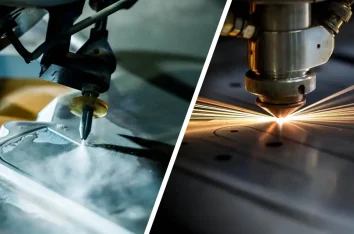
Selecting appropriate cutting technology for specific applications becomes increasingly important as specifications tighten. Understanding Laser Cutting vs. Waterjet: Choosing the Right Process for Automotive and EV Components helps fabricators match process capabilities to customer requirements. Battery components sensitive to thermal effects may require waterjet cutting, while high-volume motor laminations favor laser processing for throughput efficiency.
Regional Advantages Support Local Suppliers
Michigan fabricators benefit from proximity to engineering teams specifying components and qualifying suppliers. Face-to-face collaboration during prototype development and production ramp accelerates problem resolution compared to remote supplier relationships. The ability to deliver sample quantities quickly for testing enables faster iteration cycles that compressed vehicle development timelines demand.
Transportation economics favor regional suppliers for bulky components where shipping costs represent significant percentages of part value. Battery enclosures and motor housings qualify as such components, creating natural advantages for fabricators located within reasonable trucking distance of assembly plants. Just-in-time delivery requirements for production components further advantage nearby suppliers who can respond to schedule changes without lead time penalties.
Major manufacturers continue expanding Michigan operations, with General Motors, Ford, and LG Energy Solution all announcing multi-billion-dollar investments in battery and EV production facilities across the state. This timeline creates urgency for fabricators seeking to establish supplier relationships before production ramps saturate available capacity. Early movers who develop capabilities and relationships during facility construction phases position themselves advantageously as volume requirements materialize.
Capability Development Priorities
Material capabilities represent the most fundamental requirement for EV parts manufacturing. Aluminum cutting without thermal distortion or edge property degradation addresses battery enclosure requirements. Copper cutting supports motor component and busbar applications. Specialty alloys and composites emerging in next-generation designs require process validation before production commitments.
Secondary operations differentiate fabricators competing for complete component business. Deburring, tapping, countersinking, bending, and welding transform cut blanks into finished parts ready for assembly. Fabricators offering these capabilities capture more value per component while simplifying customer supply chain management. Surface finishing requirements for corrosion protection or aesthetic purposes add further differentiation opportunities.
Equipment capacity and scalability matter as production volumes ramp. Prototype suppliers capable of hundreds of pieces annually cannot serve programs requiring thousands weekly without investment in additional equipment and workforce. Understanding target customer production trajectories helps fabricators plan capacity investments appropriately.
Motor City Metal Fab: Your Precision Cutting Partner
Motor City Metal Fab provides precision laser and waterjet cutting from our Taylor, Michigan facility, serving automotive and manufacturing customers throughout Southeast Michigan. Our capabilities span aluminum, stainless steel, mild steel, and specialty materials with secondary operations including deburring, tapping, countersinking, bending, welding, and surface finishing.
Our Services Include:
- Laser and Waterjet Cutting Services – Materials up to 60 by 120 inches, thicknesses to 1 inch for metals, plus stone, glass, ceramics, composites, plastics, rubber, and foam
Ready to Discuss Your Project? Contact Motor City Metal Fab to explore how our precision cutting and secondary operation capabilities can support your EV component requirements.
Works Cited
“Michigan a Top State for Electric Vehicle & Battery Investments, Bringing Home $16.6 Billion, Creating 16,300 Good-Paying Jobs.” Michigan Economic Development Corporation, 14 Mar. 2023, www.michiganbusiness.org/press-releases/2023/03/top-state-for-ev-battery/. Accessed 24 Nov. 2025.
“Novelis, Shape Corp., and Metalsa Partner to Develop EV Battery Enclosures.” Light Metal Age Magazine, 12 Mar. 2025, www.lightmetalage.com/news/industry-news/automotive/novelis-shape-corp-and-metalsa-partner-to-develop-ev-battery-enclosures/. Accessed 24 Nov. 2025.
Related Articles
- Michigan Leads Nation in EV Manufacturing Investment as Automotive Supply Chain Transforms
- Laser Cutting vs. Waterjet: Choosing the Right Process for Automotive and EV Components