The surge in electric vehicle manufacturing creates urgent demand for precision-cut components across battery enclosures, motor housings, and structural assemblies. Manufacturers selecting fabrication partners must understand fundamental differences between laser and waterjet cutting technologies to specify appropriate processes for their applications. Material properties, tolerance requirements, production volumes, and thermal sensitivity all influence optimal process selection for automotive and EV component manufacturing.
Both technologies have evolved substantially as manufacturers invest in advanced capabilities. The global laser cutting machines market reached approximately $4.2 billion in 2024 and is projected to grow to $7.3 billion by 2034, reflecting a compound annual growth rate of 6.5 percent according to market research from Exactitude Consultancy. This expansion stems largely from automotive, aerospace, and electronics sectors demanding increasingly precise cutting capabilities. Understanding how Michigan Leads Nation in EV Manufacturing Investment as Supply Chain Transforms provides context for regional fabricators evaluating technology investments.
Laser Cutting: Speed and Precision for Metals
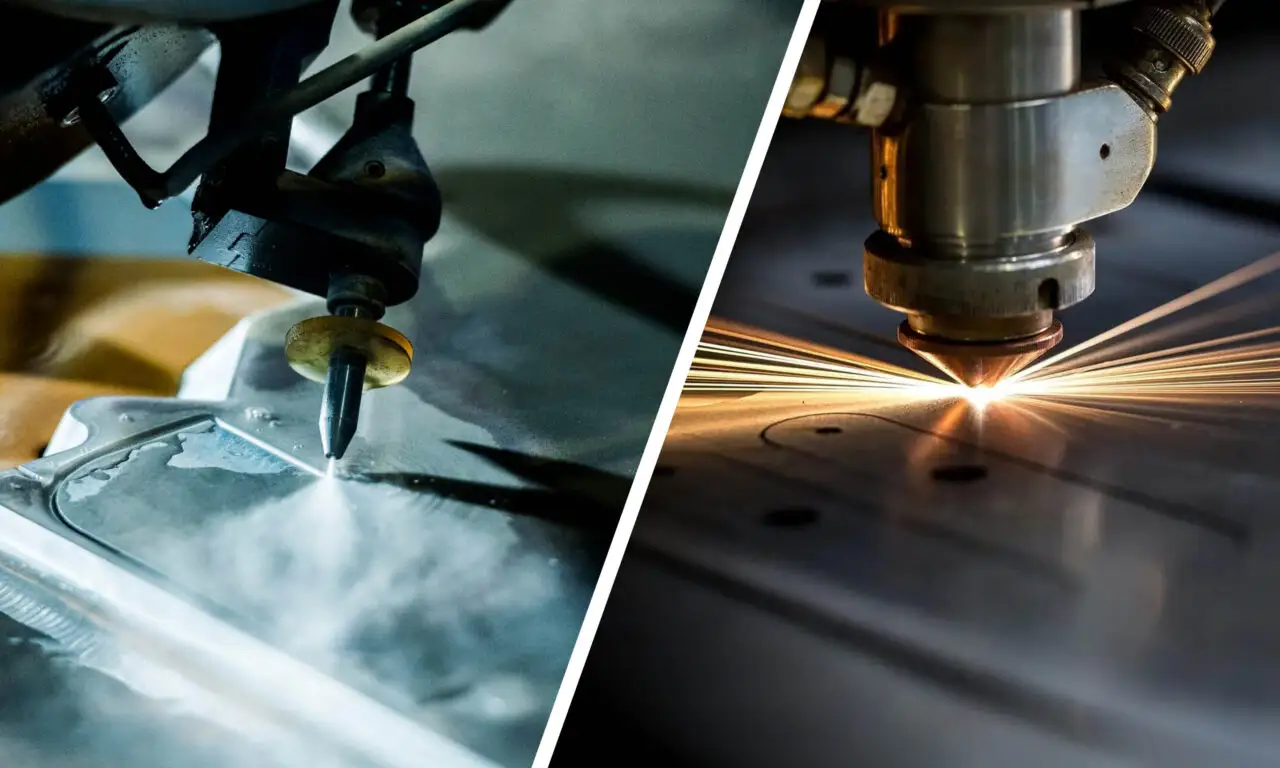
Fiber laser cutting delivers exceptional speed and precision on metals within its thickness range, making it the preferred technology for high-volume production of steel and aluminum components. Modern fiber lasers achieve cutting speeds that dramatically outpace older CO2 systems while consuming less energy and requiring reduced maintenance. These efficiency gains translate directly to lower per-piece costs for production applications where laser cutting suits the material and geometry requirements.
Laser cutting introduces heat into the workpiece at the cut edge, creating a heat-affected zone where material properties may change. For many automotive applications, this heat-affected zone remains acceptably small and creates no functional concerns. However, certain materials and applications require cold cutting processes that preserve original material properties throughout the entire part. Battery components and thermal management systems sometimes fall into this category where metallurgical consistency matters across the complete surface area.
Thin to medium-thickness metals represent laser cutting’s sweet spot. Mild steel up to one inch, stainless steel to three-quarters inch, and aluminum to half-inch thickness cut efficiently on fiber laser systems. Beyond these ranges, cut quality diminishes and speed advantages erode relative to alternative processes. The precision achievable—typically plus or minus 0.005 inches—satisfies most automotive tolerance specifications for sheet metal components.
Waterjet Cutting: Versatility Without Heat
Waterjet cutting uses a high-pressure stream of water mixed with abrasive garnet to erode material without introducing heat. This cold cutting process preserves material properties at the cut edge, eliminating heat-affected zones that could affect component performance. The waterjet cutting machine market reached $1.86 billion in 2025 and is expected to reach $2.39 billion by 2030 at a 5.14 percent CAGR according to Mordor Intelligence analysis, with automotive producers representing 27.5 percent of 2024 market turnover as EV manufacturing drives demand for cutting hard-to-machine alloys.
Material versatility distinguishes waterjet technology from laser alternatives. Waterjet cuts virtually any material—metals, glass, stone, ceramics, composites, rubber, and foam—using identical equipment and setup procedures. This flexibility proves valuable for fabricators serving diverse customer bases or for manufacturers whose component mix spans multiple material categories. Single-source fabrication capability simplifies supply chain management and quality control processes.
Waterjet cutting excels on thick materials where laser efficiency diminishes. Stacked cutting of multiple thin sheets achieves production efficiencies for high-volume applications. The absence of thermal effects makes waterjet essential for materials sensitive to heat, including certain aluminum alloys used in battery enclosures where edge properties must match base material specifications precisely. Examining Why Michigan’s EV Boom Creates Opportunities for Precision Metal Fabricators helps manufacturers understand how these capabilities align with emerging component requirements.
Application-Specific Selection Criteria
Battery enclosure fabrication increasingly favors waterjet cutting for aluminum components where thermal sensitivity and edge quality requirements exceed laser cutting capabilities. The aluminum alloys specified for crashworthiness and thermal management often require cold cutting to maintain properties throughout the component. Complex geometries with internal cutouts benefit from waterjet’s omni-directional cutting capability and consistent edge quality regardless of cut direction.
Motor lamination stacks present different requirements favoring laser cutting’s speed advantages on thin electrical steel. Production volumes for motor components typically justify dedicated tooling and optimized processes where laser’s throughput advantages compound across thousands of units. The heat-affected zone on lamination edges, while present, remains small enough that motor performance stays within specifications for most designs.
Prototyping and low-volume production often favor waterjet cutting regardless of material. Setup flexibility and material versatility enable fabricators to produce sample quantities without programming delays or tooling changes that add cost and time to prototype cycles. The ability to cut any material on the same equipment supports rapid iteration during product development phases where material specifications may change between prototype rounds.
Quality and Integration Considerations
Edge quality requirements vary by application and subsequent manufacturing processes. Components requiring welding may benefit from laser cutting’s consistent kerf width and perpendicular edges. Parts destined for assembly without secondary operations may require waterjet’s burr-free edges that eliminate deburring steps. Understanding downstream processes helps specify appropriate cutting technology for each component.
Production integration increasingly demands digital connectivity between cutting equipment and manufacturing execution systems. Modern laser and waterjet equipment supports data exchange enabling real-time production monitoring, predictive maintenance, and quality traceability. These capabilities matter for automotive supply chains requiring documentation of process parameters for each component produced.
The choice between laser and waterjet cutting ultimately depends on specific application requirements rather than blanket technology preferences. Fabricators offering both technologies provide customers with access to optimal processes for each component without single-source limitations. This capability alignment serves manufacturers whose product mix spans materials and specifications suited to different cutting technologies.
Motor City Metal Fab: Your Precision Cutting Partner
Motor City Metal Fab operates both laser and waterjet cutting systems from our Taylor, Michigan facility, enabling process selection optimized for each customer’s specific requirements. Our capabilities span metals, stone, glass, ceramics, composites, plastics, rubber, and foam materials with tolerances meeting automotive industry specifications.
Our Services Include:
- Laser and Waterjet Cutting Services – Laser tolerances to ±0.005 inches, waterjet tolerances to ±0.010 inches, materials up to 60 by 120 inches, plus secondary operations including deburring, tapping, and welding
Ready to Discuss Your Project? Contact Motor City Metal Fab to determine which cutting process best serves your component requirements.
Works Cited
“Laser Cutting Machines Market.” Exactitude Consultancy, Mar. 2025, exactitudeconsultancy.com/reports/laser-cutting-machines-market/. Accessed 24 Nov. 2025.
“Waterjet Cutting Machine Market Size, Growth, Share & Forecast Report 2030.” Mordor Intelligence, June 2025, www.mordorintelligence.com/industry-reports/global-waterjet-cutting-machine-market-growth-trends-and-forecast-2020-2025. Accessed 24 Nov. 2025.
Related Articles
- Michigan Leads Nation in EV Manufacturing Investment as Automotive Supply Chain Transforms
- Why Michigan’s EV Boom Creates Opportunities for Precision Metal Fabricators