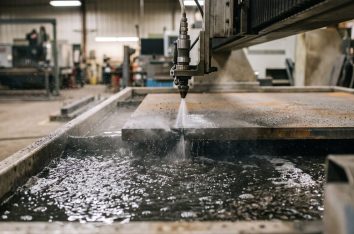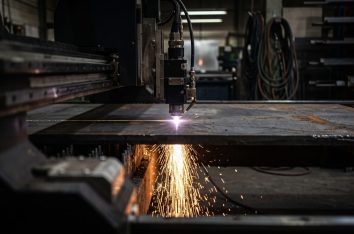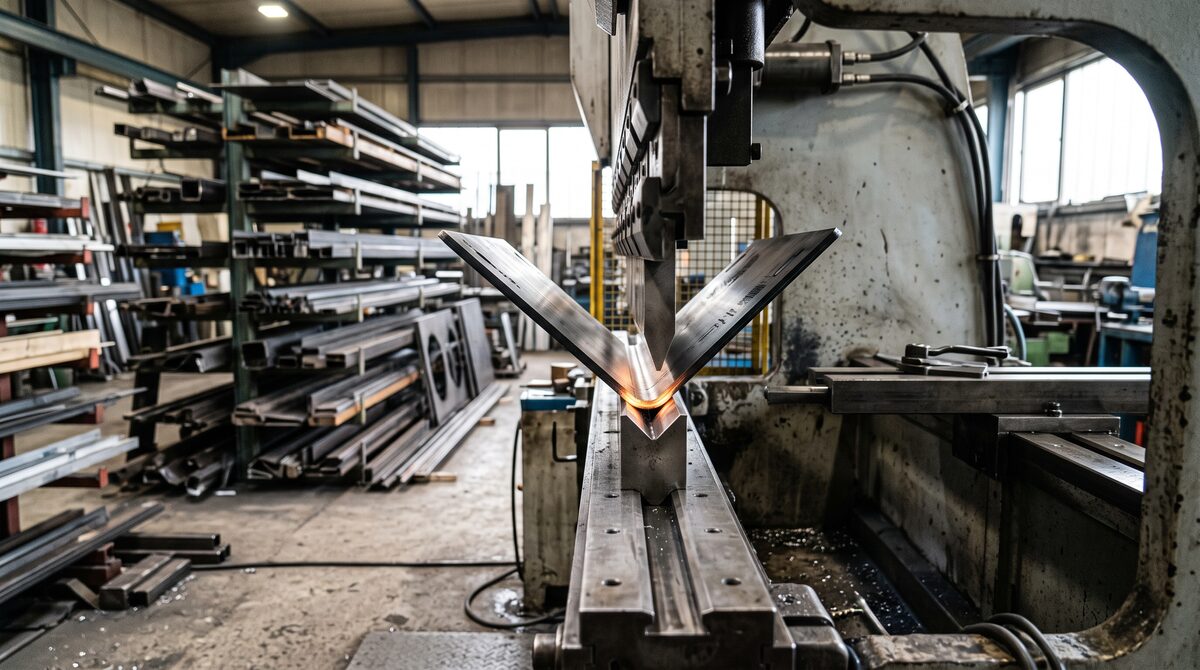
The cutting quote is the smallest number in the job. Buyers who compare vendors on that number alone are optimizing the wrong line.
NIST’s Manufacturing Extension Partnership makes the underlying point plainly: on average, more than half of a manufacturer’s total spending happens in the supply chain. A cut blank is not a part. It is an input to four or five more operations, and every handoff between those operations is a place where cost and time accumulate quietly.
The path a blank actually takes
A bracket leaves the cutting table and still needs deburring, forming, welding, blasting, and coating before anyone can bolt it to anything. Five operations after the one that got quoted.
At a shop that outsources three of them, that is three purchase orders, three freight legs, three receiving inspections, and three chances for the part to sit on someone else’s floor waiting behind other work. Each stop adds a queue the buyer cannot see and cannot expedite, because the shop that holds the part has its own priorities and its own customers.
None of that appears on the cutting quote.
What each handoff actually costs
MEP recommends total cost of ownership as the frame for procurement decisions, and defines it to include the expenses beyond purchase price — freight, tariffs, longer lead times, higher inventory costs, and the overhead of managing distant suppliers. The same body notes that total cost of ownership also weighs the risk of lost sales and poor customer experience.
Apply that frame inside a single part’s routing and the arithmetic changes. Every vendor in the chain adds coordination overhead, a margin, and a queue position. On a prototype run of twenty pieces, coordination frequently costs more than the machining does, because the engineering time spent chasing three vendors is worth more per hour than the spindle time being chased.
MEP also works with manufacturers to reduce manufacturing critical path lead time by attacking bottlenecks. A part crossing four company boundaries has bottlenecks nobody owns.
The technical handoffs that go wrong
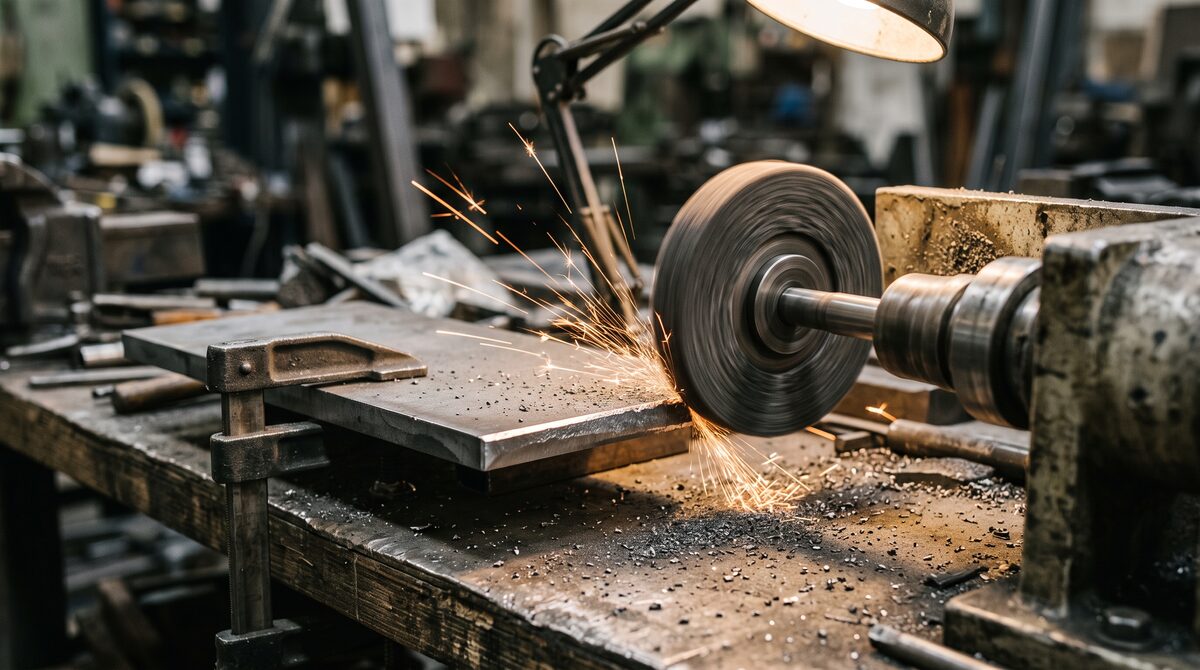
Cut edge into weld prep. Welding is regulated work with its own body of requirements under OSHA’s Subpart Q, which covers oxygen-fuel gas welding and cutting, arc welding and cutting, and resistance welding as separate disciplines. It is also unforgiving of a poorly prepared joint. A cut edge carrying dross, an oxide film, or a rim hardened by the heat-affected zone brings all of that into the weld.
Weld into machining. Welding distorts. A part machined before it is welded may not hold its tolerance afterward, so operation sequence has to be set by someone who can see the whole routing rather than one station of it.
Fabrication into coating. Powder coating needs a clean surface with a proper blast profile. Weld spatter, mill scale, and oil left behind by an upstream vendor turn into adhesion failures downstream, and the part comes back stripped and rerun at somebody’s expense.
Forming into fit. A bend developed against nominal material thickness lands differently on stock that arrived at the other end of its tolerance band. The shop that formed it rarely learns this until assembly.
Everything into assembly. Parts that measure correctly on their own do not automatically fit together. Tolerance stack surfaces at assembly, long after the shop that cut the blanks has invoiced and moved on.
Prototype runs punish handoffs hardest
Volume forgives coordination cost. A production order of ten thousand pieces spreads vendor overhead across enough parts that nobody notices it, and the relationships settle into a rhythm where each shop knows what the last one sends.
Short runs work the other way. On twenty or fifty pieces there is no rhythm to settle into, every job is a first article, and the fixed cost of moving material between four companies lands on a handful of parts. A revision mid-run makes it worse, because the change has to propagate through every vendor in the chain before anyone can restart, and the ones downstream have already scheduled around the old drawing.
This is the work growing fastest in the metro Detroit supply base. Prototype programs, validation builds, and short production runs come with more revisions, more material changes, and more process decisions per part than long production ever required.
Why buyers are consolidating vendors
MEP frames domestic sourcing as a way to shorten the supply chain and reduce uncertainty, and notes that proximity makes it easier to assess the quality of what you are receiving directly rather than through paperwork.
The same logic applies one level down, at the shop rather than the country. A part that stays in one building has no freight legs between operations and no ambiguity about who owns a defect. When the weld distorts the frame, the people who cut it, formed it, and will coat it are in the same room, looking at the same part, that day. Nobody is filing a claim against a vendor two counties over or waiting on a return authorization.
That is not a scheduling promise. It is a structural difference in how many separate places a job can stall.
What to ask a cutting vendor
Ask what happens to the part after the table, and listen for whether the answer names operations or names other companies. Both are valid business models, and only one of them puts the coordination burden on you.
Ask who owns the part if a downstream operation reveals an upstream problem. A shop that performs both operations answers that question in one sentence. A shop that subcontracts will describe a process.
Ask whether anyone reviewed the print for what comes next, or only for what it takes to cut the profile. Kerf compensation, bridge placement, pierce points, and grain direction all look different depending on whether the blank is going to a press brake or a weld fixture.
Process selection sits underneath all of it. The trade-offs in laser cutting vs waterjet cutting look different once downstream operations are on the table. Motor City Metal Fab runs the cut and the operations after it under one roof, which is the whole reason the sequence gets planned as one job.
Motor City Metal Fab: One Shop, Every Operation
Motor City Metal Fab is a family-owned shop in Taylor, Michigan serving metro Detroit. Cutting, machining, forming, welding, coating, and assembly all happen in one building, so a part never waits on an outside vendor.
Our Services Include:
- Full Service List — Cutting, machining, forming, bending, welding, coating, assembly, and shipping
- Assembly and Shipping — Finished assemblies packed and sent from the same building that built them
Have a print to quote?
Contact Motor City Metal Fab with your drawing, material, and quantity.
Works Cited
- United States, National Institute of Standards and Technology. “Supply Chain Management.” Manufacturing Extension Partnership, 14 July 2025, www.nist.gov/mep/supply-chain.
- United States, Occupational Safety and Health Administration. “1910 Subpart Q — Welding, Cutting and Brazing.” U.S. Department of Labor, www.osha.gov/laws-regs/regulations/standardnumber/1910/1910SubpartQ.