Michigan’s factory payrolls are not all moving the same direction, and the exception is worth a look.
Michigan State University’s Center for Economic Analysis puts state manufacturing employment at 593,740 for 2026, a decline of 0.3 percent. Durable goods drop 0.5 percent. Primary metal manufacturing falls 0.8 percent, machinery manufacturing 0.6 percent, motor vehicle manufacturing 1.4 percent, and other transportation equipment 1.7 percent. Fabricated metal product manufacturing runs the other way at 72,000 jobs, up 1.3 percent — the only metal subsector in the durable-goods forecast gaining ground this year.
That split says something about the work itself. Vehicle assembly volume is soft while the shops that cut, form, and weld metal are busier, because the parts reaching them are smaller in quantity and more varied in material. Prototype programs, validation builds, and short production runs take up a growing share of the mix, and those jobs come with more material changes and more process decisions per part than a long production run ever did.
For a buyer sending out a print, an old question now carries higher stakes: laser cutting vs waterjet cutting. Choosing wrong costs money in ways the cutting quote never shows.
What each process actually does
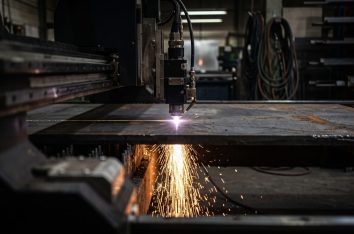
A fiber laser melts or burns material along the cut path, and an assist gas blows the molten metal out of the kerf. Assist gas choice changes the mechanism. Nitrogen cuts by melting alone. Oxygen adds an exothermic reaction that pushes cutting speed on structural steel well past what melting mode reaches at the same power.
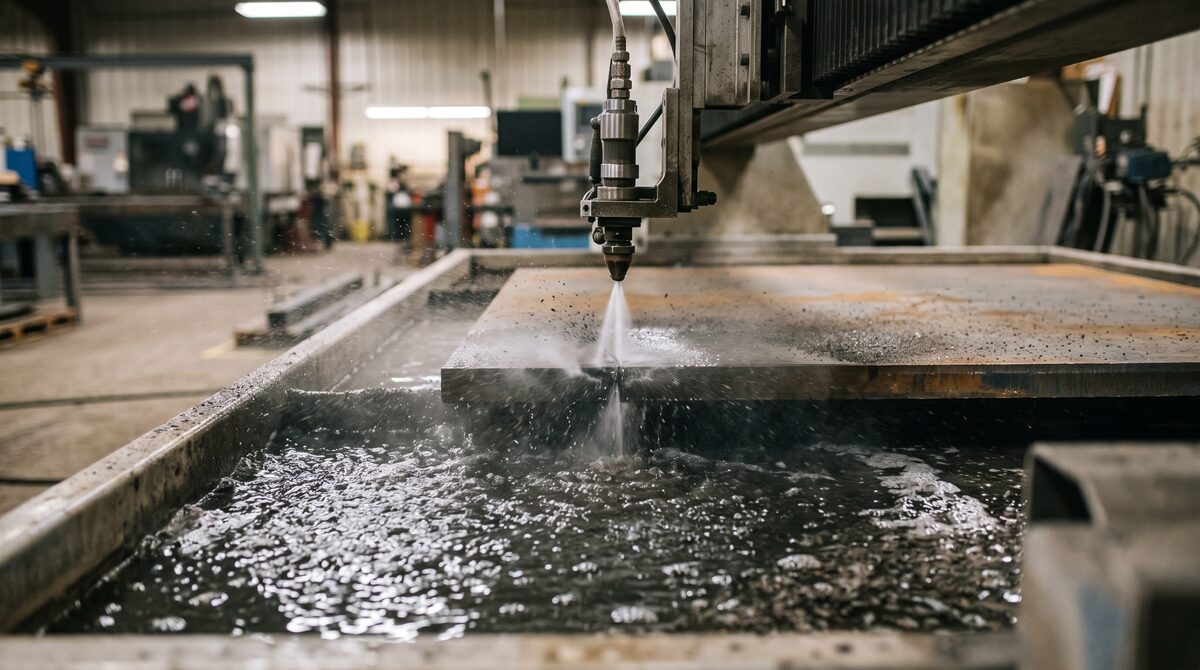
An abrasive waterjet erodes material with high-pressure water carrying garnet grit. Nothing melts. The cycle runs slower and the kerf is wider, yet the process will cut almost anything put under it — heavy plate, stone, glass, ceramics, composites, and materials that would burn under a beam.
The two are less competitors than a pair. A shop running both picks the process to suit the part rather than fitting the part to whichever machine is on the floor.
Four questions that settle most jobs
Material. Copper and aluminum reflect light and pull heat away quickly, so they behave differently under a laser than mild steel does. Aluminum needs nitrogen at real pressure to clear the molten metal out of the kerf cleanly. Non-metals go to waterjet by default, since there is no version of a thermal process that leaves a composite intact.
Thickness. Laser speed and edge quality both fall away as sections get heavier. Past a point, waterjet becomes the shorter path even though it runs slower, because the laser cut that succeeds still needs cleanup the waterjet cut does not.
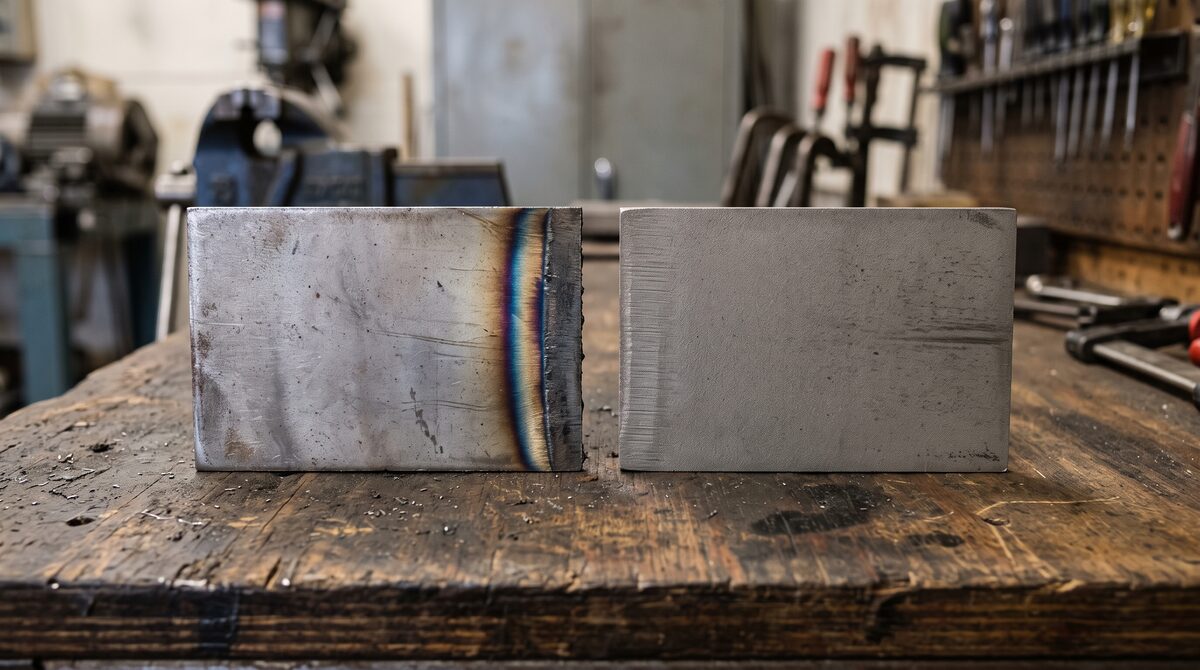
Heat tolerance. Laser cutting changes the metal beside the cut. Hardened tool steels, heat-treated alloys, and parts carrying tight flatness callouts often cannot accept that change, which is why the heat-affected zone deserves its own conversation before anyone picks a process.
What happens next. A blank headed for bending, machining, welding, or coating carries requirements the cut has to respect. Those secondary operations after laser cutting are where a cheap cut turns expensive.
The material math changed
Material is a larger share of part cost than it used to be, so nesting efficiency, kerf width, and scrap rate all move the final number in ways they did not when stock was cheap.
A laser’s narrow kerf matters here. Tight nesting on a sheet, with common-line cutting where the geometry allows it, pulls real cost out of a job before a single part comes off the table. On a short run, the sheet yield often swings the price more than the cycle time does. Waterjet’s wider kerf gives some of that back, and on thin sheet the difference is easy to measure.
Thick plate flips the comparison. A long waterjet cycle can still win by removing a secondary operation from the routing, and the hour saved at a mill is worth more than the hour spent at the table.
The part mix keeps shifting
Lightweighting has pushed aluminum and composite into places that used to be plain steel, and every one of those substitutions changes the cutting answer. A shop that only cuts steel well will quote those parts anyway.
What this looks like by industry
Automotive prototype work brings brackets and structural pieces that have to survive validation testing, so edge condition matters as much as profile. EV and hydrogen fuel cell builders need enclosures in aluminum and stainless where thermal input is a design constraint. Food service equipment runs sanitary stainless sheet. Gas and oil work leans on corrosion-resistant alloys headed for harsh service.
Different requirements, one common thread: the right cut depends on the part, not on the vendor’s equipment list.
Cost pressure on both sides of the quote
Nobody is quoting in a soft market. The Bureau of Labor Statistics put average weekly wages across all Detroit-area industries at $1,545 in the fourth quarter of 2025, just under the $1,569 national figure. Labor, material, and machine time all come out of the same part price, and a process chosen badly eats the margin twice — once on the table, once in rework.
The question behind the question
Buyers usually ask which process is better. The more useful question is which shop can run both and will say plainly which one a given part wants. A shop with one machine finds a way to quote every job on that machine, and the buyer discovers the mismatch three operations later.
Ask what the cut edge will look like when it comes off the table. Ask what the part needs after cutting, and whether the shop can do those operations. Ask whether the answer changes if the material changes, because on a prototype program it usually does.
A cutting vendor that engages with those questions is reading the print rather than the purchase order. At Motor City Metal Fab, both processes sit in the same building as the machining, welding, and coating that follow them, so the process conversation and the routing conversation happen at the same time.
Motor City Metal Fab: One Shop, Every Operation
Motor City Metal Fab is a family-owned shop in Taylor, Michigan serving metro Detroit. Cutting, machining, forming, welding, coating, and assembly all happen in one building, so a part never waits on an outside vendor.
Our Services Include:
- Laser and Waterjet Cutting — A 3-axis 4000-watt fiber laser alongside waterjet, so the process fits the part
- Automated Sawing and Material Processing — Bar and plate broken down in house before anything reaches the cutting table
Have a print to quote?
Contact Motor City Metal Fab with your drawing, material, and quantity.
Works Cited
- Center for Economic Analysis. “Michigan Employment.” Michigan State University, 29 Oct. 2025, www.canr.msu.edu/cea/economic-forecast/michigan/michigan-employment.
- United States, Bureau of Labor Statistics. “Detroit Area Economic Summary.” U.S. Department of Labor, 5 Aug. 2026, www.bls.gov/regions/midwest/summary/blssummary_detroit.pdf.