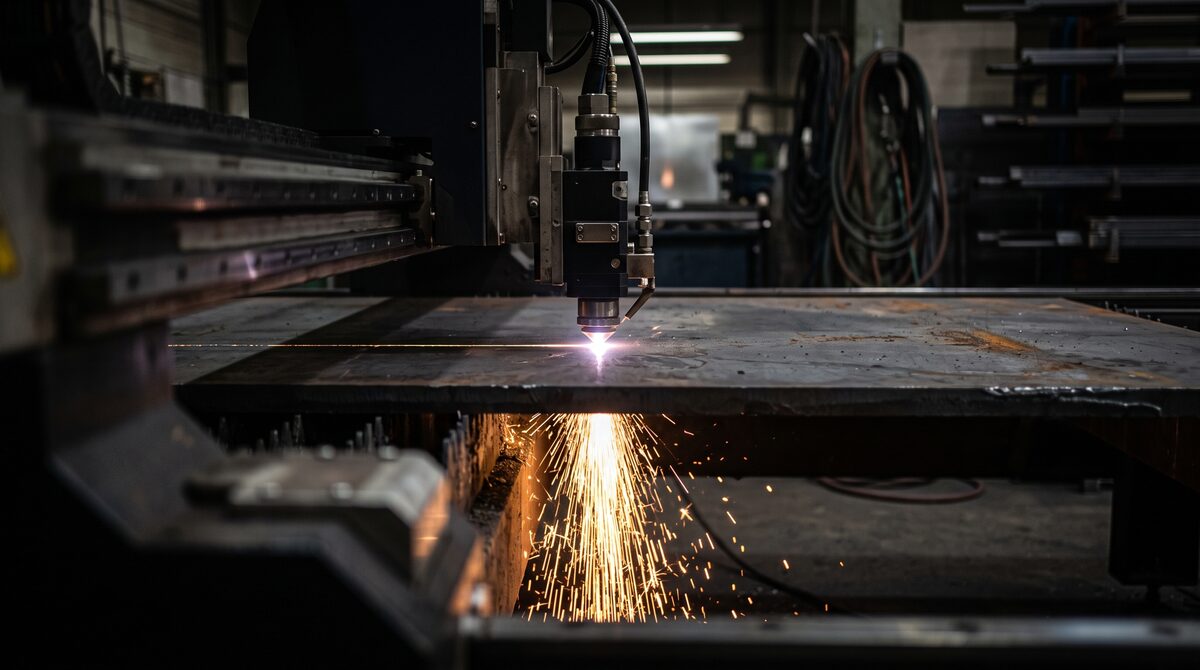
A laser cut looks clean. The metal under the edge tells a different story.
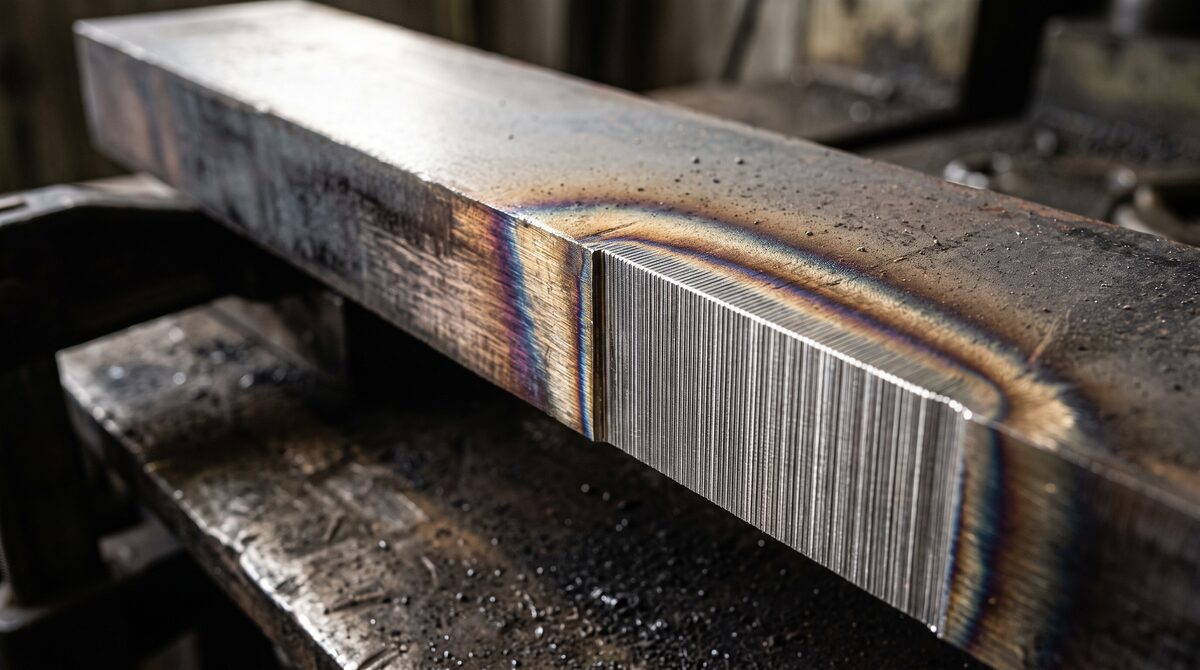
Research published in January 2026 in the journal Materials put numbers on it. Working across three common engineering alloys — S355J2 structural steel, AISI 304 stainless, and AlMg3 aluminum — the team measured microhardness at set distances back from the cut edge on twelve parameter sets. Every material showed edge hardening reaching roughly 0.4 mm into the part. S355J2 spiked hardest, with edge readings near 700 HV 0.1 against a core that settled around 150 HV 0.1. AISI 304 showed the steepest relative jump, climbing about 155 percent above a core hardness of roughly 145 HV 0.1.
That is the heat-affected zone, and it is invisible on a first-article inspection that only checks dimensions.
Why hardening at the edge matters
Harder is not automatically better. The same study notes that raised microhardness improves wear resistance while it may reduce ductility at the cut edge.
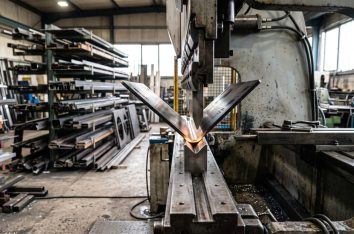
Ductility is what a part spends when it gets bent. A blank with a hardened rim that has to take a tight bend radius is a blank looking for a crack along the bend line, and it is one of the clearest cases where the choice between laser cutting vs waterjet cutting should be made before the sheet is loaded. Springback shifts too, because the material near the edge no longer behaves like the material in the middle of the sheet, and a bend deduction developed on virgin stock stops predicting the result.
Structure changes as well as hardness. On S355J2, the researchers tracked microstructural change extending 143 microns in from the treated edge on one sample set and 121 microns on another, with the core shifting away from its baseline ferritic-pearlitic condition. The AlMg3 aluminum developed a visible remelted layer with a refined, fine-grained structure, and structural changes carried roughly 130 to 150 microns in.
Thermal properties explain the pattern
The differences track the metallurgy rather than the machine. S355J2 melts somewhere around 1460 to 1520 degrees Celsius with moderate thermal conductivity, so heat leaves the cut zone slowly and the result is a narrow, sharply bounded affected region. AlMg3 melts far lower, near 600 to 650 degrees, and conducts heat several times faster, which spreads the energy and produces a more diffuse zone even when the remelted layer measures about the same depth.
Practical translation: a steel part hides its damage in a thin band you can machine away. An aluminum part spreads it over a wider region that is harder to remove without changing the geometry.
Where the zone becomes a real problem
Parts that get machined afterward. A hardened rim wears tooling faster and can push a cutter off line, so the tolerance you were chasing gets harder to hold and the tool cost climbs.
Parts that get welded. The cut edge becomes the weld prep. Feeding a pre-hardened edge into a weld joint stacks one thermal cycle directly on top of another.
Heat-treated stock. If the metallurgy was bought and paid for in a furnace, a thermal cutting process gives some of it back at every edge.
Composites and layered materials. The polymer matrix evaporates well before the reinforcing fiber does, leaving damage that no visual inspection catches and no rework recovers.
Thin parts with tight flatness. Localized heating puts stress into a sheet that had none, and the part can move after it leaves the table.
What the assist gas is doing
Gas selection is not a footnote. The 2026 study found that assist gas pressure drove surface quality on structural steel more than any other single variable. Oxygen-cut S355J2 reached its best finish at the lowest pressure tested, and the worst result in the series came from the highest pressure, which the researchers attributed to uncontrolled ejection of molten material out of the kerf.
Aluminum behaved almost inversely. Nitrogen pressure had to stay high to clear molten metal effectively, and the poorest surface came from the lowest pressure tested. Raising beam power beyond the manufacturer’s recommended setting made the finish worse rather than better, pointing to excess energy going into the part rather than the cut.
One finding cuts against expectation. AISI 304 showed high heat resistance in that testing, with no melt zone and no visible microstructural change at the treated edge, credited to the alloying elements that resist oxidation at temperature. Stainless is often a better laser candidate than its reputation suggests.
When waterjet is the answer
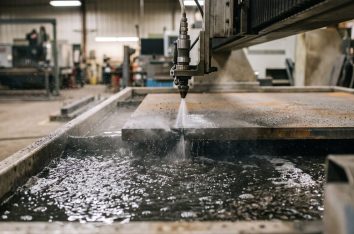
Abrasive waterjet cuts cold. Water and garnet erode material rather than melting it, so grain structure, hardness, and heat treatment at the edge come through unchanged. There is no remelted layer to machine off and no hardened band to fight during forming.
That matters more as the part mix shifts. The U.S. Department of Energy points out that lightweight materials such as high-strength steel, aluminum, and glass fiber-reinforced composites are especially important for electric vehicles, since reduced structure weight offsets battery and motor mass. Composite and heat-treated aluminum parts are exactly the population where thermal cutting causes trouble, and exactly the population growing fastest in the metro Detroit supply base.
How to specify it
Say what the edge has to do, not just where it has to be. A drawing that calls out a bend radius, a weld prep, a post-cut heat treatment, or a surface finish requirement gives the shop enough information to route the part correctly the first time. A drawing carrying only a profile and a dimensional tolerance leaves the process choice to whoever is loading the table that shift.
Flag the material condition too. Annealed and hardened stock of the same alloy want different answers, and a shop that does not know which one showed up will treat both the same.
Edge condition is rarely the last word on its own. The secondary operations after laser cutting frequently decide whether a hardened rim is acceptable at all. Motor City Metal Fab runs both processes in the same building as the machining and forming that follow, so the edge condition gets decided against the whole routing.
Motor City Metal Fab: Reading the Print Before the Table
Motor City Metal Fab is a family-owned shop in Taylor, Michigan serving metro Detroit. Cutting, machining, forming, welding, coating, and assembly all happen in one building, so a part never waits on an outside vendor.
Our Services Include:
- CNC Machining — Prototype and short-run machining in copper, aluminum, and stainless
- CAD Designing and CAM Manufacturing — Print review and toolpath development before a part reaches the floor
Have a print to quote?
Contact Motor City Metal Fab with your drawing, material, and quantity.
Works Cited
- Selech, Jaroslaw, et al. “Influence of Laser Cutting Parameters on the Microhardness, Roughness, and Microstructure of AISI 304, S355J2, and AlMg3 Alloys.” Materials, vol. 19, no. 2, 7 Jan. 2026, p. 240, pmc.ncbi.nlm.nih.gov/articles/PMC12843296/.
- United States, Department of Energy. “Lightweight Materials for Cars and Trucks.” Transportation Technologies Office, www.energy.gov/cmei/vehicles/lightweight-materials-cars-and-trucks.