

New welding technology is moving faster than most Michigan manufacturers can keep up with. Robotic cells that run 24 hours, AI systems that catch defects before the arc even moves on, laser welding that produces joints in seconds instead of minutes – these are not future-of-manufacturing concepts anymore. They are running in fabrication shops across Southeast Michigan right now. At Motor City Metal Fab, we work with automotive suppliers, aerospace contractors, and industrial manufacturers across the Detroit metro, and the gap between shops using these technologies and shops still on manual processes is widening every quarter. This guide covers what the new technologies actually do, where each one applies, how they reduce rework and cut cycle time, and what Michigan manufacturers need to evaluate before adopting them.
What Is the Latest Welding Technology in 2026?
The welding industry has consolidated around four technology categories that are genuinely reshaping production economics: collaborative robots (cobots), AI-powered weld monitoring, laser hybrid welding, and digital twin simulation. Each one addresses a different bottleneck – labor dependency, defect rates, cycle time, and process repeatability. Understanding what separates them matters before committing capital.
Cobots and Collaborative Welding Robots
Cobots are the fastest-growing segment in welding automation. Unlike traditional industrial welding robots – which require safety caging, extensive programming, and weeks-long installation – cobots are designed to work within arm’s reach of human operators. They carry tactile sensors that halt operation the moment contact is detected, and most modern units can be reprogrammed between jobs in hours rather than days. For Michigan job shops running high-mix, lower-volume work, that flexibility is what makes automation practical for the first time. Deployment costs have dropped roughly 60% compared to traditional robot cells, and a two-bay cobot welding setup can match the output of three to four manual welders while holding consistent parameters across every shift. The global robotic welding equipment market is projected to reach $10 billion by the end of 2026 – cobots are driving the majority of that growth because they fit manufacturing environments where hard automation never could.
AI-Powered Weld Monitoring Systems
AI weld monitoring captures arc parameters – voltage, current, wire feed speed, travel speed – at millisecond intervals and runs them against learned defect signatures in real time. When a parameter drifts outside the acceptable range, the system either flags the weld for inspection or adjusts the parameter automatically before the bead is finished. Machine learning algorithms built on thousands of weld cycles now predict defects with accuracy above 94%, meaning shops catch bad welds before they reach downstream assembly or inspection. The practical outcome: scrap rates that used to run 3-5% in manual environments drop below 1% with AI monitoring in place. For Michigan manufacturers supplying automotive tier-1 contracts where weld traceability and documented quality are contract requirements, AI monitoring also generates the data trail automatically – a benefit that goes beyond productivity into compliance.
Laser Hybrid Welding
Laser hybrid welding combines a focused laser beam with a conventional MIG arc in a single pass. The laser provides deep penetration and precise heat control; the MIG arc fills the joint and handles gap tolerance. The result is a process that runs 5-10 times faster than traditional MIG on structural work, produces a minimal heat-affected zone (HAZ), and handles fit-up variation that pure laser welding cannot. Michigan’s automotive supply chain has adopted laser hybrid extensively for EV battery enclosures, where precision and thermal control are both critical – aluminum battery cases cannot tolerate the distortion that conventional welding introduces.
Digital Twin Simulation and IoT-Connected Welding
Digital twin simulation models the weld joint, material, and process parameters in software before the first arc is struck. It predicts distortion, identifies stress concentration points, and optimizes the weld sequence to minimize warpage – eliminating the trial-and-error rework that costs shops time and material on prototype runs. Alongside simulation, IoT-connected welding power sources now transmit operating data to cloud dashboards via standard industrial protocols, enabling predictive maintenance scheduling based on actual machine behavior rather than fixed calendar intervals. A machine flagging anomalies in arc stability two weeks before a failure is a fundamentally different cost structure than one that fails mid-production run.
How Robotic Welding Systems Improve Productivity
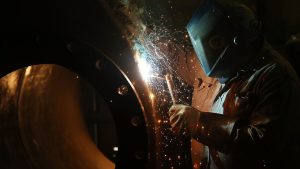
The productivity case for robotic welding is straightforward at the numbers level: automated systems improve throughput by 300-500% over manual welding, operate continuously without fatigue, and hold weld parameters within ±2% tolerance across millions of repetitions. The more useful question for Michigan manufacturers is where those gains actually show up in the cost structure – and where the limits are.
Throughput and Cycle Time Gains
A robotic welding cell running qualified procedures on a repeat assembly produces at a steady arc-on rate that manual stations cannot match. Manual welding involves repositioning time, breaks, fatigue degradation in parameter consistency across a shift, and natural variation in travel speed. Robotic cells eliminate all of those variables. For assemblies with defined weld sequences – frames, brackets, enclosures, structural subassemblies – a typical Michigan job shop sees cycle time reductions of 40–60% after implementing a robotic cell on their highest-volume part families. That reduction compounds across multi-shift operations.
To understand how advanced welding technology intersects with dimensional precision across the full fabrication workflow, see how CNC machining maintains tight tolerances on components that feed directly into welded assemblies – keeping the tolerance stack controlled from raw material to finished part.
Rework and Defect Reduction
The defect rate gap between robotic and manual welding is significant: robotic systems average below 0.1% defect rates in production environments versus 3-5% in manual welding, according to AWS Foundation data. Each defect avoided eliminates downstream costs – rework labor, scrap material, delayed shipment, and potential warranty exposure. For manufacturers running high-compliance work in aerospace or medical device supply chains, defect rate documentation is itself a contract requirement. Robotic systems generate that data as a byproduct of operation.
Challenges for Small and Mid-Size Michigan Fabricators
The honest picture includes the barriers. Initial investment for a complete robotic welding cell runs $50,000-$250,000 depending on reach, payload, positioner configuration, and tooling. ROI timelines in medium-volume environments typically land at 18-24 months, which requires capital planning and a financing strategy. Integration into existing production lines involves fixturing modifications, workflow sequencing changes, and operator retraining – all of which extend the ramp-up period. The workforce transition matters too: robotic welding requires operators who understand programming, troubleshooting, and quality monitoring rather than pure arc technique. Michigan community colleges and technical schools have partnered with fabricators to build apprenticeship tracks that address this, but the skill gap is real, and the training pipeline is still catching up to demand.
For manufacturers weighing automation against the region’s skilled labor shortage, the situation is covered in depth in this post on the welder shortage crisis hitting Southeast Michigan manufacturing – which directly affects the ROI calculation for automation investment.
Laser Welding vs. Traditional MIG Welding: When Each Makes Sense
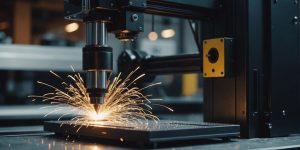
Laser welding and MIG welding are not competitors in most manufacturing environments – they solve different problems. Choosing between them depends on material thickness, joint geometry, production volume, and whether distortion control or penetration depth is the priority.
Where Laser Welding Wins
Laser welding delivers its advantages on thin materials (typically under 3mm), precision assemblies, dissimilar metal joining, and applications where heat input must be minimized. The focused beam creates a narrow weld pool with a heat-affected zone a fraction of what MIG generates – which means aluminum components, stainless steel housings, and complex geometries come off the weld station with minimal distortion and no post-weld straightening. Processing speed is a major differentiator: next-generation fiber laser systems run 5-10 times faster than TIG welding and significantly faster than conventional MIG on appropriate material thicknesses. In aerospace applications, laser welding is now standard for joining titanium and aluminum-lithium alloy components where warpage is a disqualifying defect. Michigan’s EV battery manufacturing supply chain relies on laser welding for aluminum enclosures specifically because thermal control and cleanliness of the joint are requirements the process meets reliably at production volume.
For a deeper look at how laser technology works across cutting and joining applications at MCMF, the laser and waterjet cutting services page covers our full laser capability in precision cutting – which often feeds parts directly into the welding workflow.
Where MIG Welding Still Dominates
MIG welding remains the right choice for structural steel over 6mm, outdoor and field applications, high-deposition-rate work, and assemblies where deep penetration into thick material is the requirement. It tolerates joint fit-up variation that laser welding cannot, requires less precise fixturing, and runs on consumable wire that keeps operating costs lower per pound of weld metal deposited. For heavy fabrication – frames, heavy equipment components, structural subassemblies – MIG and its variants (FCAW for even higher deposition, SAW for long seam work) are still the production workhorses. The “better” choice is always application-specific.
Applications in Automotive and Aerospace
Michigan’s automotive manufacturing environment uses both processes across different assemblies. Body-in-white structural work uses robotic MIG at high volume. EV battery enclosures and motor housings use laser. Interior component joining uses ultrasonic. Prototype work uses TIG for flexibility. Advanced fabrication shops in the Detroit area that can run multiple welding processes in-house handle the full range of automotive supplier work without subcontracting individual operations – which is a direct cost and lead time advantage. Welding and fabrication services that span multiple processes under one roof eliminate the handoffs where quality and schedule risk accumulate.
Ultrasonic Welding: The Precision Process Michigan Manufacturers Are Adopting
Ultrasonic welding uses high-frequency vibration – typically between 15 and 70 kHz – to generate localized friction heat at the joint interface, bringing the materials into a plastic state that forms a molecular-level bond without introducing bulk heat into the assembly. No filler metal. No shielding gas. No arc. The process runs in cycle times under two seconds and uses up to 80% less energy than resistance welding for comparable joints.
How It Reduces Distortion and Energy Use
Because ultrasonic welding does not melt the parent material – it plasticizes the interface zone only – distortion and warpage are virtually eliminated. This matters significantly for precision assemblies where dimensional stability after joining is a specification requirement. Electronic enclosures, sensor housings, medical device components, and EV wiring harness connectors are typical applications where conventional welding heat would disqualify the process entirely. The energy efficiency advantage also compounds across high-volume production: for Michigan manufacturers running automotive wiring harness or electronic component assembly, the operating cost difference over a production year is material.
Key Industries Using Ultrasonic Welding in Michigan
In Michigan’s manufacturing ecosystem, ultrasonic welding is active across automotive (wiring harnesses, interior trim assemblies, battery terminal welding in EVs), electronics (smartphone components, circuit connections), and medical devices (clean room-compatible joins with no contamination risk). The EV transition is specifically driving adoption of ultrasonic welding for battery pack assembly because the process can join dissimilar conductor materials – copper to aluminum, for example – without the intermetallic compounds that resistance welding creates at the joint. Michigan’s position at the center of the EV supply chain transition makes this a growing process requirement, not a niche one.
For context on how Michigan’s EV manufacturing growth is creating broader demand for advanced fabrication capabilities, see our analysis of Michigan’s EV transition and the demand it creates for custom metal fabrication.
How to Modernize Your Welding Process with Digital Technology
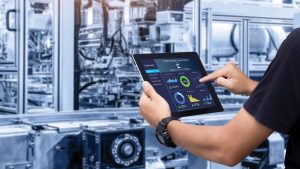
Modernizing a welding process does not mean replacing every piece of equipment. It means introducing the data collection and control systems that turn welding from a craft-dependent variable into a measurable, manageable production process. Digital welding technology operates at three levels: process control (parameter management in real time), quality documentation (traceability and compliance records), and predictive operations (maintenance forecasting and yield optimization).
Why Digital MCU Control Is Becoming the New Standard
Microcontroller unit (MCU) control in modern welding power sources replaces the analog knob-and-dial parameter setting that older equipment uses. A digital MCU system sets and holds voltage, amperage, wire feed speed, and arc length electronically – eliminating the drift that happens when an analog machine heats up, when contact tips wear, or when input power fluctuates. The practical effect is weld-to-weld consistency that analog machines cannot achieve. On high-mix production work with tight tolerance requirements, MCU-controlled machines reduce parameter-related defects substantially, and they log every weld cycle automatically for quality records. That last point is driving adoption: customers in aerospace, defense, and medical device supply chains increasingly require documented weld data with shipments, and MCU-controlled machines generate it as a byproduct of operation.
Weld Data Analytics and Real-Time Monitoring
IoT-enabled welding power sources transmit operating data – arc voltage, wire feed rate, travel speed, heat input – to cloud or on-premises analytics platforms after every weld cycle. Over time, this data set reveals process drift before it produces defects, identifies equipment that needs maintenance before it fails, and builds the empirical baseline for process optimization. Sensor technologies feeding these systems include thermal imaging cameras, acoustic emission sensors for crack detection, and high-speed cameras capturing arc behavior at up to 10,000 frames per second. For manufacturers running ISO 3834 – or AS9100-certified welding operations, this digital data trail is moving from optional to required by their customer quality agreements.
Digital vs. Manual Welding Documentation
Manual weld documentation – paper travelers, handwritten weld logs, binder-based WPS records – creates audit exposure and limits traceability. When a weld failure occurs in the field, tracing it back to the specific welder, machine, parameters, and time of production is slow and often impossible with paper systems. Digital weld management systems (WQMS) capture operator identification, machine ID, weld procedure specification applied, and all measured parameters tied to each weld ID on the part. That data ships with the part as a digital package. For tier-1 automotive and aerospace customers, this capability is becoming a vendor qualification criterion. Shops still running paper documentation are increasingly disadvantaged in competitive bids.

How Advanced Filler Metal Technologies Enhance Welding Productivity
Filler metal selection is one of the most overlooked productivity variables in welding operations. Most shops standardize on a small number of wire types and stay there – but the range of available filler metal formulations has expanded significantly, with meaningful differences in deposition rate, spatter generation, and mechanical properties of the finished joint.
Metal-cored wires, for example, produce higher deposition rates than solid wire at equivalent amperage, run at faster travel speeds, and generate significantly less spatter – reducing post-weld cleanup labor that often runs 30-40% of total welding time in manual operations. Low-hydrogen electrodes and flux formulations designed for high-strength steel produce the minimum hydrogen diffusion that prevents cold cracking in structural work. Nickel-bearing filler metals handle dissimilar metal applications where standard wire degrades joint properties. The right filler metal selection, matched to the specific base material and application requirement, reduces rework, improves mechanical properties, and cuts cycle time – without adding capital equipment cost.
For automotive manufacturers working with high-strength steel, aluminum alloys, or the dissimilar metal combinations that EV component assembly increasingly demands, filler metal selection is a process optimization lever that pays back immediately. Reviewing CAD design and CAM manufacturing services alongside welding process planning catches material-filler compatibility issues before the first piece runs.
Welding Safety Improvements Through Automation and Advanced Technology
Automated welding systems reduce welder injuries by approximately 86% compared to fully manual operations, according to OSHA data. The mechanisms are straightforward: automation removes the operator from direct arc exposure, eliminates repetitive motion that causes cumulative musculoskeletal injury, and keeps personnel away from fume and UV radiation zones that create long-term health hazards.
Modern fabrication environments add wearable sensors that monitor exposure to fume particulates and UV radiation in real time, alerting workers before cumulative exposure limits are approached. Computer vision systems detect improper joint fit-up before the arc starts – catching the setup errors that cause burn-through, undercut, and structural failures before they become a scrapped assembly. Cobot welding systems include tactile and proximity sensors that halt all motion when a person enters the operating zone, making collaborative operation genuinely safe rather than theoretically safe.
The quality benefit of improved safety is real and underappreciated. Studies in controlled manufacturing environments show that welders working in ergonomically optimized, properly ventilated conditions produce measurably fewer defects than those working in environments with poor air handling, awkward fixture positioning, or high thermal discomfort. Safety investment and quality investment overlap significantly in welding operations.
How New Welding Technology Is Reshaping Detroit and Southeast Michigan Manufacturing
Detroit and Southeast Michigan operate one of the highest concentrations of welding employment in the country. The Great Lakes region’s manufacturing base – automotive assembly, tier-1 and tier-2 supply chain, aerospace fabrication, heavy equipment – represents a market where welding technology adoption directly affects competitiveness for supplier contracts.
Michigan’s EV transition is the single largest driver of technology change in local fabrication shops right now. Battery enclosure welding, motor housing assembly, thermal management component fabrication, and lightweight structural work for EV platforms all require welding capabilities – laser precision, ultrasonic for terminal connections, robotic consistency for high-volume battery pack components – that differ from the steel-dominant processes that served the ICE vehicle supply chain. Shops in Taylor, Downriver, Dearborn, and the broader Southeast Michigan corridor that have invested in advanced welding systems are winning contracts that their unmodified competitors cannot quote.
The welder labor shortage compounds this dynamic. The American Welding Society projects a shortfall of over 330,000 welding professionals nationally by 2028. Michigan is at the front of that shortage due to the concentration of demand and an aging workforce. Shops that automate the high-volume, repetitive welding work – freeing their experienced welders for complex fabrication, setup, and quality oversight – are better positioned to scale output than those competing for the same shrinking pool of manual welding labor.
Motor City Metal Fab operates in Taylor, Michigan, serving Detroit, the Downriver corridor, and Southeast Michigan manufacturers with welding and fabrication services that integrate CAD/CAM review, in-house CNC machining, and advanced welding processes under one roof. That in-house breadth is what allows clients to move from design to finished welded assembly without the quality and schedule risk that comes from coordinating multiple vendors. Michigan manufacturers evaluating advanced welding adoption can contact our team for a process consultation and free quote on their specific fabrication requirements.
For a broader view of how Michigan’s manufacturing evolution is creating new opportunities for fabricators adopting advanced capabilities, see why Michigan’s EV boom creates opportunities for precision metal fabricators.
Frequently Asked Questions
Q1: What is the latest technology in welding in 2026?
The leading welding technologies in 2026 are AI-powered robotic welding systems with adaptive learning, laser hybrid welding that combines laser precision with MIG fill-pass capability, and ultrasonic metal welding for joining dissimilar materials without heat. Digital MCU-controlled power sources and IoT-connected weld monitoring platforms are also standard in advanced fabrication shops running compliance-grade work.
Q2: Why is digital MCU control becoming the new standard in welding?
Digital MCU control holds weld parameters electronically rather than relying on analog circuitry, which drifts with temperature and equipment wear. The result is arc stability and parameter consistency that analog machines cannot maintain across a full production shift. MCU-controlled machines also log every weld cycle automatically, generating the traceability records that aerospace, automotive, and medical supply chains increasingly require with each shipment.
Q3: What are the latest advancements in welding and fabrication technologies?
The most significant recent advancements are welding cobots (deployable in hours, not months), AI-driven defect detection running at production speed with greater than 99% accuracy, fiber laser welding systems processing at 5–10x the speed of TIG, and digital twin simulation that eliminates prototype trial-and-error by modeling weld distortion before the first arc is struck. IoT weld monitoring and cloud-based analytics are also reshaping how fabrication shops manage quality and equipment health.
Q4: How can manufacturers streamline their welding process with technology?
Start with a welding audit to identify the three to five highest-volume repeat assemblies in the current workflow – those are the automation candidates. Introduce MCU-controlled power sources to eliminate parameter drift. Add digital documentation at the weld station to replace paper travelers. Then evaluate cobot automation for the repeat work while keeping manual capability for complex or low-volume fabrication. Doing all three simultaneously is not required; each step produces measurable ROI on its own.
Q5: What technology helps reduce weld spatter and rework?
Metal-cored filler wire reduces spatter significantly compared to solid wire at equivalent parameters. MCU-controlled machines with pulse capability produce cleaner arcs with less spatter than constant-voltage machines running the same wire. At the process level, laser welding essentially eliminates spatter for compatible material thicknesses. At the monitoring level, AI weld inspection catches the parameter conditions that produce spatter-prone arcs before they produce a defective weld, allowing parameter correction mid-run.
Q6: Is welding advanced manufacturing?
Yes. Modern welding operations that integrate robotic automation, computer vision inspection, digital twin simulation, and IoT data collection are squarely within the Industry 4.0 framework of advanced manufacturing. The distinction between welding as a trade and welding as advanced manufacturing lies in the control, measurement, and data infrastructure around the arc – not the arc itself.
Q7: How can productivity be enhanced with advanced filler metal technologies?
Metal-cored wires run at higher deposition rates and faster travel speeds than solid wire, cutting arc-on time per unit. Low-spatter formulations reduce post-weld cleanup labor that often runs 30-40% of total time in manual operations. Matched properly to base material and application, filler metal upgrades are among the lowest-cost, fastest-ROI process improvements available – typically requiring no capital equipment change, only process re-qualification.
Q8: How can AI-enhanced welding automation reduce rework and scrap in high-mix production?
AI weld monitoring systems learn the parameter signatures of good and defective welds across a production history and apply that knowledge in real time. In high-mix environments where different parts run on the same equipment with different procedures, AI monitoring validates that the correct parameters are active before welding starts and flags deviations as they occur – not after the part is completed and inspected. The result in typical high-mix shops is scrap reduction of 60-80% compared to manual inspection workflows, with full data traceability per weld.
Q9: What are the advantages of robotic welding over manual welding?
The core advantages are throughput (300-500% improvement in production-environment comparisons), consistency (±2% parameter tolerance held across millions of repetitions), defect rate (below 0.1% versus 3-5% manual), and 24/7 operation capability. Robotic welding also removes operators from arc, fume, and UV exposure – reducing injury rates by up to 86%. The limitation is flexibility: manual welding handles complex geometry, low-volume work, and unusual joint configurations that robots require significant programming time to address.
Q10: How can Michigan manufacturers get started with welding automation?
Walk the production floor and identify repeat assemblies with defined weld sequences – those are the starting candidates. Document current cycle times and defect rates to establish the baseline ROI case. Contact local fabrication partners and automation integrators who understand Michigan’s automotive and industrial supply chain context. Motor City Metal Fab works with Michigan manufacturers on exactly this kind of process review – contact our team for a free quote and consultation.
